Heatwave in Europe and Mortality: Spain Estimates 212 Heat-Related Deaths in 4 Days, UK Breaks June Record
Europe is facing not just a hot end to June, but a deadly heatwave. Spain has estimated hundreds of deaths linked to extreme temperatures, the United Kingdom has broken its June temperature record for the second consecutive day, France has seen dozens of water-related tragedies, and WMO warns that extreme heat is already affecting millions of people, transport, schools, workplaces, agriculture and energy systems.
Key point: Europe’s heatwave has become not only a comfort issue, but a mortality issue. In Spain, the MoMo mortality monitoring system estimated 212 heat-related deaths in just four days, from June 21 to June 24. In the United Kingdom, 36.7°C was preliminarily recorded in Merryfield, Somerset, on June 25, setting a new national June record. WMO warns that heat continues to expand across Europe, with temperatures in many areas running 3–10°C above normal and locally exceeding 40°C.
Important: “heat-related deaths” do not always mean a direct diagnosis of heatstroke. Heat often worsens cardiovascular, respiratory, kidney and chronic diseases, intensifies dehydration, increases accident risk, overloads the body and can trigger deadly situations near water.
Why this heatwave has become deadly
The European heatwave of late June 2026 is dangerous not only because of extreme daytime temperatures. The main problem is duration, hot nights, humidity, overheated cities and poor overnight recovery. When temperatures do not fall enough after sunset, the heart and blood vessels continue to work under stress.
In several countries, the heat has already turned into a public-health crisis. Spain is estimating hundreds of additional deaths, France is reporting dozens of drownings among people trying to escape the heat in water, while records are falling in the United Kingdom and Switzerland. This shows that Europe is increasingly facing summer conditions for which many cities, homes, schools and workplaces are not fully prepared.
The most alarming signal is that mortality is rising quickly. In Spain, the estimated number of heat-related deaths increased each day: 13 cases on June 21, 38 on June 22, 66 on June 23 and 95 on June 24. This shows how quickly the human body and the health system can enter the danger zone during prolonged heat.
Spain: 212 heat-related deaths in four days
Spain has become one of the clearest examples of how heat turns into a demographic threat. The MoMo system, which tracks daily all-cause mortality and estimates the impact of temperature extremes, linked 212 deaths to high temperatures between June 21 and June 24.
This came during Spain’s first official heatwave of 2026. Temperatures reached or exceeded 40°C in many areas, while Cantabria saw extreme values up to 43.7°C, described as the highest recorded value for the northern region.
The most striking feature of Spain’s situation is the sharp daily rise in estimated mortality. The longer the heat persists, the stronger the cumulative impact on people becomes: sleep worsens, dehydration increases, heart strain grows, concentration drops and vulnerable groups tolerate each following day more poorly.
United Kingdom: new June record and red heat warnings
The United Kingdom set a new preliminary June temperature record for the second consecutive day. On June 25, 36.7°C was recorded in Merryfield, Somerset. This surpassed previous June records and became a symbol of how quickly the country’s climate reality is changing, especially in a place where many homes, schools and transport systems were not designed for prolonged heat.
Wales also preliminarily set a new June maximum of 35.9°C in Cardiff, while Northern Ireland equalled its June record with 30.8°C in Castlederg. Unusually warm nights were also recorded: in Cardiff, the temperature did not fall below 23.5°C overnight, setting a new June minimum-temperature record for the United Kingdom.
Why hot-night records are especially dangerous: a person can tolerate a hot day more easily if the body cools down overnight. But if the night remains very warm and humid, recovery is disrupted. The next day, the risk of heat exhaustion, cardiovascular strain and worsening health rises sharply.
France: heat, drownings and dangerous attempts to cool down
France has faced another deadly side of extreme heat: people are rushing to water to cool down. According to reports on the European heatwave, dozens of people have drowned in France since June 18 while trying to find relief from high temperatures. Many incidents were linked to swimming in unsafe or unguarded locations.
Such tragedies are not always perceived as “heat deaths,” but heat becomes the direct trigger for dangerous behavior. People go into rivers, canals, quarries and water bodies without lifeguards, jump into cold water after overheating, overestimate their strength or get caught in currents. That is why mortality during heatwaves is not made up only of heatstroke, but also of accidents.
WMO: heat is affecting millions of people
The World Meteorological Organization warns that the current heatwave is affecting millions of people across Europe. Its impact goes far beyond medicine: transport, work schedules, schools, agriculture, infrastructure, energy systems and ecosystems are all under pressure.
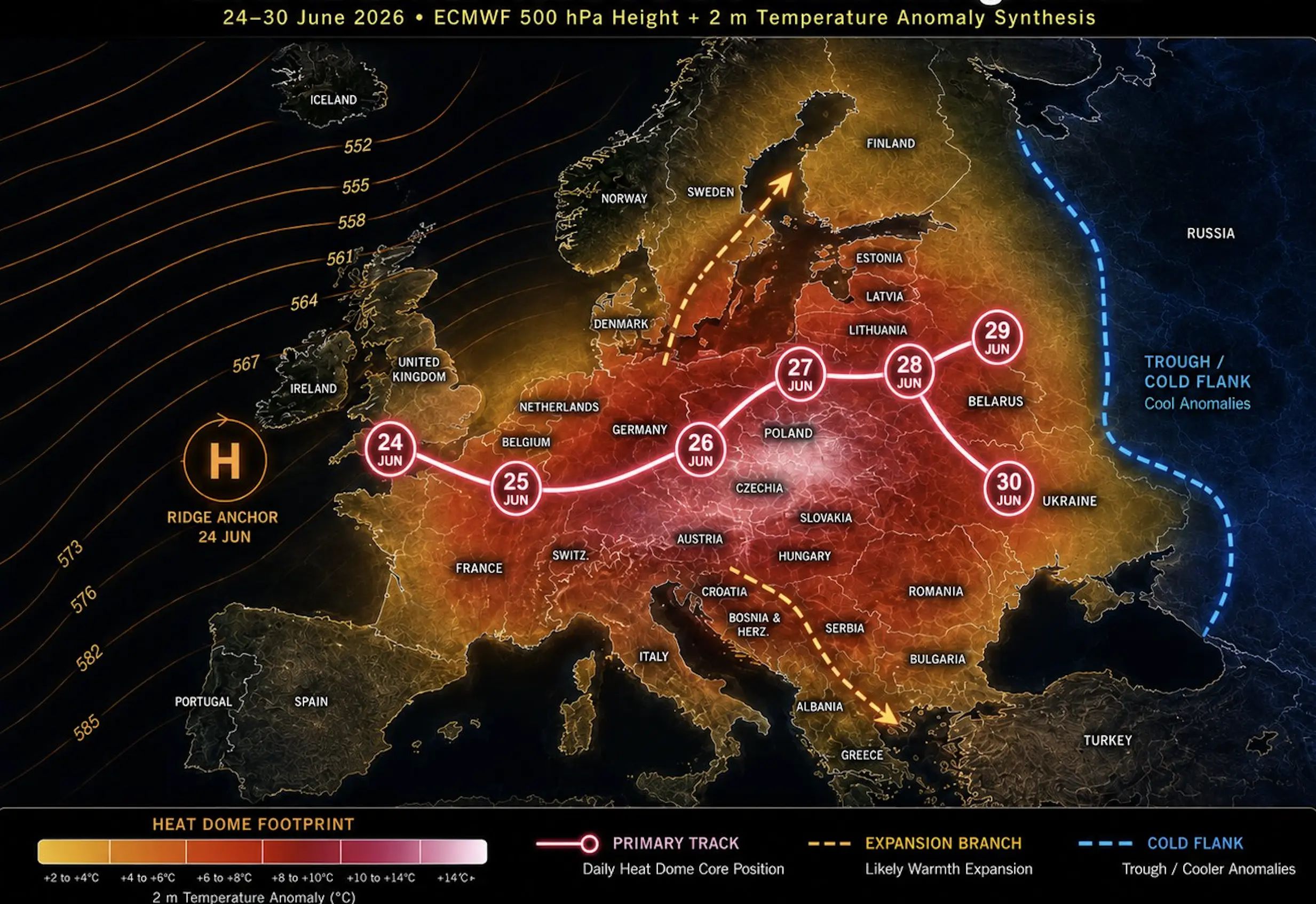
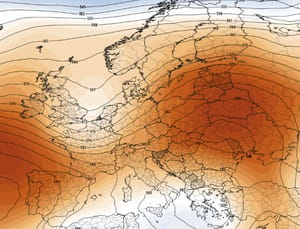
According to regional climate services, temperatures across much of western, central and southern Europe are running 3–10°C above seasonal norms, and in some areas they are exceeding 40°C. The heat is spreading farther north and east, affecting not only the Mediterranean but also Germany, Poland, Czechia, the Alps, Denmark, southern Scandinavia and the Baltic region.
Heat is a systemic risk. It overloads hospitals, transport, power grids, schools, construction sites, farms and emergency services at the same time. That is why the most dangerous consequences often appear not in one single day, but when heat persists for several days in a row.
Risk map: where Europe is most exposed now
Country / region
What is happening
Main risks for people
Spain
First official heatwave of 2026, temperatures near and above 40°C, 212 heat-related deaths in four days according to MoMo estimates
Urban heat, thunderstorms after overheating, transport and power-grid strain
Balkans and southeastern Europe
Heat is expected to intensify as the main hot zone shifts
Heat, fires, drought, severe storms along air-mass boundaries
Why heat kills quietly and unevenly
Heat-related mortality is often underestimated because it does not always look like a sudden disaster. An earthquake or flood is visible immediately, but heat acts more quietly. It worsens chronic diseases, disrupts sleep, thickens the blood through dehydration, increases heart strain, and raises the risk of stroke, heatstroke and kidney failure.
The most vulnerable groups are older adults, children, pregnant people, people with cardiovascular or respiratory diseases, people without air conditioning, homeless people, older people living alone, outdoor workers, tourists and residents of upper floors in poorly cooled buildings.
The key risk group is people who cannot cool down at night. If an apartment overheats, there is no air conditioning, windows face the sun and the city does not cool down overnight, the body is hit not once a day, but almost around the clock.
Heat mortality: direct and indirect causes
Type of risk
How heat affects the body or behavior
Who is most vulnerable
Heatstroke
Body temperature rises and the body loses its ability to cool itself
Older people, children, athletes, outdoor workers
Cardiovascular complications
The heart works under strain, raising the risk of heart attack and stroke
People with hypertension, heart failure, older adults
Dehydration
Fluid volume drops, increasing weakness, falls, clotting risk and kidney problems
Older people, children, people taking diuretics
Hot nights
The body does not recover, sleep worsens and stress accumulates
Urban residents, people on upper floors, homes without cooling
Drownings
People enter dangerous water bodies while trying to cool down
Young people, tourists, exhausted people or those who have consumed alcohol
Workplace risks
Concentration drops and the risk of injuries, overheating and mistakes rises
Construction workers, farmers, couriers, road workers, municipal services
Why European cities are especially vulnerable
Many European cities were not historically built for regular temperatures near 40°C. Older homes often lack air conditioning, streets are dense, asphalt and stone store heat, and nighttime cooling is weak. As a result, cities can function like heat traps.
Upper floors, attic apartments, poorly ventilated homes, buildings without green space nearby, districts with heavy asphalt coverage and older people living alone are especially at risk. That is why heat mortality often concentrates not only where the maximum temperature is highest, but where people cannot cool down properly.
Schools, work and transport: what is already changing
Authorities in several countries are already changing school schedules, restricting mass events, opening cooling centers, issuing warnings for vulnerable groups and advising employers to adjust working hours. In some Italian regions, restrictions have been introduced on outdoor work during the hottest hours.
Transport is also becoming vulnerable. Heat can deform rails, overheat roads, weaken power-grid stability, worsen air conditioning performance in trains and buses, delay flights and increase the risk of failures in metro and commuter systems.
What governments should do during heat like this
Measure
Why it is needed
Where it is especially important
Cooling centers
Give people a safe place during the hottest hours
Large cities, districts with older populations, poorer neighborhoods
Checking on older people living alone
Prevent silent deaths at home
Cities, homes without air conditioning, upper floors
Tourist cities, districts with large foreign-born populations
What people should do during extreme heat
Avoid unnecessary sun exposure between 11:00 and 17:00.
Drink water regularly, even before strong thirst appears.
Avoid alcohol in heat: it worsens dehydration and lowers control.
Check on older relatives and neighbors at least twice a day.
Never leave children, older people or animals in a car, even for a few minutes.
Do not swim in canals, rivers with currents, quarries or places without lifeguards.
Close windows and curtains during the day; ventilate early in the morning and late in the evening.
Seek medical help if dizziness, confusion, severe weakness or hot dry skin appears.
When will the heat start to ease?
The heat will not end across all of Europe at the same time. In some regions, thunderstorms and fronts will bring relief, while in others the anticyclone will keep temperatures high for longer. British forecasts point to a gradual easing of heat through the weekend, but before that, thunderstorms may bring strong winds, lightning, hail and local flooding.
On the continent, the hot zone is shifting north and east. This means that after western Europe, a stronger heat impact may reach Germany, Poland, Czechia, the Alpine region, the Balkans, Denmark, southern Scandinavia and the Baltic states. Even if France or Spain gets some relief, heat may still intensify across eastern and southeastern Europe.
Main takeaway
The late-June 2026 European heatwave has already become deadly. Spain estimates 212 heat-related deaths in four days. The United Kingdom has broken its June temperature record for the second consecutive day. In France, dozens of people have drowned while trying to escape the heat. WMO warns that the impact of heat is spreading to millions of people and affecting not only health, but also the economy, transport, schools, workplaces, agriculture and infrastructure.
The main lesson from this heatwave is that Europe can no longer treat extreme heat as a rare summer inconvenience. It is a full-scale natural hazard that requires the same seriousness as storms, floods or wildfires: early warnings, cooling centers, worker protection, help for older people, safe swimming zones and constant public information.
Pogodnik app
During heatwaves, the forecast should be checked more often, especially before travel, outdoor work or going near water. In the Pogodnik app, you can track temperature, precipitation, wind, cloud cover and hourly forecasts for your location. Download the Pogodnik Android app: https://play.google.com/store/apps/details?id=com.bitltd.pogodnik
FAQ: heatwave in Europe and mortality
How many heat-related deaths did Spain estimate?
Spain’s MoMo system estimated 212 deaths linked to high temperatures between June 21 and June 24, 2026.
Why does heat increase mortality?
Heat increases strain on the heart, worsens breathing, causes dehydration, disrupts sleep, and raises the risk of heatstroke, stroke, falls and accidents.
Why are warm nights dangerous?
If temperatures remain high overnight, the body cannot cool down properly. The next day, people enter the heat already weakened, and the risk of complications increases.
What temperature record did the UK break?
On June 25, 2026, a preliminary temperature of 36.7°C was recorded in Merryfield, Somerset, setting a new June temperature record for the United Kingdom.
Why did drownings increase in France?
During heatwaves, people often rush to water to cool down. Swimming in unguarded rivers, canals, quarries and water bodies can be deadly, especially after overheating and exhaustion.
Which European countries are most at risk now?
Spain, France, the United Kingdom, Italy, Switzerland, Germany, Poland, Czechia, the Balkans, southern Scandinavia and the Baltic region are facing elevated risks from heat, storms or heat-related impacts.
What should governments do?
Governments should open cooling centers, check on older people living alone, restrict outdoor work during peak heat, adjust school schedules, issue warnings in multiple languages and improve safety around water bodies.
The Founder and Chief Meteorologist at Pogodnik.com. With over 15 years of operational experience in synoptic analysis and climate forecasting, he specializes in storm tracking, magnetic storms, and atmospheric dynamics. A recognized expert in Ukraine’s meteorological sector, he maintains strategic collaborations with global agencies, including NOAA and ECMWF, to ensure high-precision data integration. His analytical reviews and scientific contributions are regularly featured in leading media outlets dedicated to weather science and environmental trends.