Solar Eclipse 2026: August 12 Time, Path and Where to See It in Europe and the USA
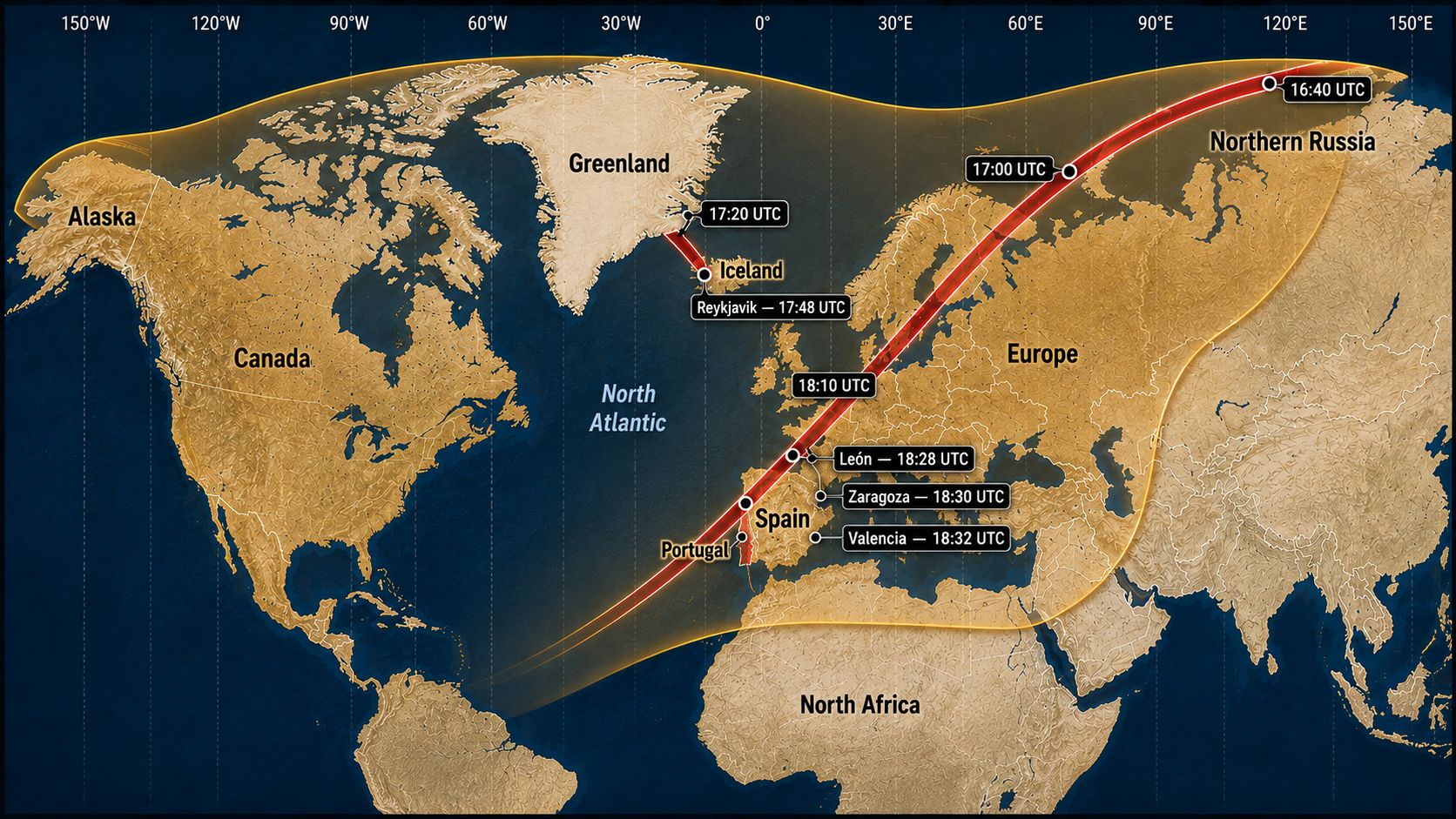
On August 12, 2026, a total solar eclipse will sweep across the high Arctic, Greenland and Iceland before crossing the North Atlantic and reaching Spain close to sunset. Europe gets the most dramatic views: western Iceland and northern Spain lie inside the path of totality, while the UK, France, Italy, Central Europe and many other countries see a deep partial eclipse. In the United States, the eclipse is partial, with the best views in Alaska and the Northeast.
- Date: Wednesday, August 12, 2026.
- Type: Total solar eclipse.
- Global maximum: 17:46:06 UTC.
- Maximum duration of totality: about 2 minutes 18 seconds.
- Path of totality: northern Russia → northeastern Greenland → western Iceland → North Atlantic → northern Spain → a tiny part of Portugal.
- Europe: a deep partial eclipse will be visible across most of the continent outside the totality path.
- United States: a partial eclipse will be visible in Alaska and parts of the northern and northeastern U.S.
- Eye protection: ISO 12312-2 eclipse glasses are required during every partial phase.

What Time Is the Solar Eclipse on August 12, 2026?
The eclipse unfolds over several hours as the Moon’s shadow moves across Earth. Local times vary by longitude and time zone, but the global UTC sequence is fixed.
| Eclipse stage | UTC time |
|---|---|
| First partial eclipse begins | 15:34:15 UTC |
| First totality begins | 16:58:09 UTC |
| Maximum eclipse | 17:46:06 UTC |
| Last totality ends | 18:34:07 UTC |
| Final partial phase ends | 19:57:57 UTC |
Where Will the Total Solar Eclipse Be Visible in Europe?
The path of totality reaches Europe in two especially accessible regions: western Iceland and northern Spain. Before that, the umbra crosses a remote part of northern Russia and northeastern Greenland.
In Iceland, the Sun will be completely covered during the late afternoon. In Spain, totality arrives in the evening with the Sun low in the western sky, creating one of the most spectacular sunset eclipse opportunities in decades.
Reykjavík, Iceland
Total eclipse
Partial phase begins around 16:47 local time. Totality begins at approximately 17:48 and lasts just over one minute in the city.
León, Spain
Total eclipse
Partial eclipse begins around 19:32 CEST. Totality occurs roughly between 20:28 and 20:30.
Zaragoza, Spain
Total eclipse
Partial phase begins around 19:34 CEST. Totality comes at approximately 20:29–20:30.
Valencia, Spain
Total eclipse
Partial phase starts around 19:38 CEST. Totality arrives at approximately 20:32–20:33, just before sunset.
Why Spain’s August 12 Eclipse Will Be a Sunset Eclipse
Spain sits near the end of the totality path. By the time the Moon’s shadow reaches the Iberian Peninsula, the Sun is already very low in the west.
Near A Coruña, maximum eclipse occurs around 20:28 local time with the Sun roughly 12° above the horizon. In Burgos, totality lasts about 104 seconds with the Sun near 8° elevation. Around Palma, maximum eclipse comes with the Sun only about 2° above the horizon.
This low angle can produce an extraordinary view, but it also makes the horizon critical. A ridge, tree line, apartment block, haze layer or low cloud bank can block the eclipse even when the rest of the sky is clear.
Best Places in Spain to Watch the Eclipse
There is no single guaranteed location because cloud cover will decide the final viewing quality. Historical AEMET cloud statistics suggest that inland parts of northern and central Spain often have better mid-August evening sky conditions than the Atlantic coast.
Historical clear or mostly clear conditions during the relevant evening period occurred roughly 30–50% of the time along parts of Galicia, Asturias, Cantabria and the Basque Country. Across inland Castilla y León, the Ebro Valley and parts of Castilla-La Mancha, historical figures were closer to 50–70%.
These are climatological statistics, not the final August 12 forecast. Check the short-range cloud forecast 24–48 hours before traveling.
Will the Solar Eclipse Be Visible in the UK?
Yes. The UK will see a deep partial eclipse, but no totality. In London, the eclipse begins around 18:17 BST, reaches maximum at about 19:13, and ends near 20:06.
Western parts of Britain will see a deeper partial phase. Because the Sun is never completely covered anywhere in the UK, eclipse glasses must remain on throughout the event.
Solar Eclipse Times Across Europe
Much of Europe will see a dramatic partial eclipse. In western and central parts of the continent, a large fraction of the Sun will be obscured close to sunset.
| City | Local maximum | Approx. phase | Time zone |
|---|---|---|---|
| London | 19:13 | Deep partial | BST, UTC+1 |
| Paris | 20:17 | About 92% coverage | CEST, UTC+2 |
| Milan | 20:20 | About 92% | CEST, UTC+2 |
| Vienna | 20:10 | About 85% | CEST, UTC+2 |
| Oslo | 19:57 | About 83% | CEST, UTC+2 |
| Stockholm | 19:56 | About 81% | CEST, UTC+2 |
| Saint Petersburg | 20:51 | About 79% | MSK, UTC+3 |
Will the August 12 Eclipse Be Visible in the United States?
Yes, but only as a partial solar eclipse. The best U.S. visibility is in Alaska and the Northeast. Farther south and west across the contiguous states, the partial phase becomes smaller or is not visible at all.
| U.S. location | Local maximum | Approx. coverage |
|---|---|---|
| Anchorage, Alaska | 08:21 AKDT | About 28% |
| Bangor, Maine | 13:53 EDT | About 24% |
| Boston, Massachusetts | 13:55 EDT | About 16% |
| Detroit, Michigan | 13:36 EDT | About 3% |
In Alaska, the eclipse takes place in the morning. Across the northeastern U.S., it occurs around midday to early afternoon. There is no totality anywhere in the United States during this eclipse.
What About Canada?
Most of Canada sees at least a partial eclipse, with stronger coverage in eastern and northern regions. Atlantic Canada gets some of the best partial views in North America.
| Canadian city | Local maximum | Approx. coverage |
|---|---|---|
| Montreal | 13:45 | About 18% |
| Toronto | 13:40 | About 8% |
| St. John’s | 15:35 | About 53% |
How to Watch the Solar Eclipse Safely
Never look directly at the partially eclipsed Sun without proper solar eye protection. Ordinary sunglasses are not safe, no matter how dark they appear.
- Use eclipse glasses or handheld solar viewers compliant with ISO 12312-2.
- Inspect filters before use and discard scratched, torn or damaged viewers.
- Do not look through a camera, telescope or binoculars while wearing only eclipse glasses.
- Cameras, binoculars and telescopes require a dedicated solar filter mounted securely on the front of the optics.
- A pinhole projector is a safe indirect viewing option.
- Eye protection may be removed only during complete totality and only for observers inside the totality path.
- Put the viewer back on immediately when any bright part of the Sun returns.

Can You Photograph the Eclipse?
Yes, but every partial phase requires a proper front-mounted solar filter on the camera lens. Concentrated sunlight can damage a sensor and can cause severe eye injury through an unfiltered optical system.
For Spain’s sunset eclipse, the Sun will be low and exposure will change rapidly. A tripod, remote shutter and pre-focused lens can help, but eye safety should always come first.
What Will Totality Look Like?
Inside the totality path, daylight collapses quickly when the Sun’s bright photosphere disappears. The solar corona becomes visible around the black lunar disk, bright planets and stars may appear, the horizon can glow in multiple directions and the air temperature often falls.
NASA plans to observe the event from a WB-57 high-altitude aircraft. By moving with the Moon’s shadow, the aircraft can extend the observing window for the solar corona to nearly three minutes.
How Long Will Totality Last?
The maximum possible totality on Earth during this eclipse is about 2 minutes 18 seconds. Most populated places get less.
Reykjavík receives a little over one minute of totality. In northern Spain, duration ranges from roughly one minute to nearly two minutes depending on the exact location within the path.
Why the 2026 Eclipse Is So Important for Europe
This is the first total solar eclipse visible from mainland Europe since 1999. For Spain, it ends an even longer gap: the Iberian Peninsula has not experienced a comparable total-eclipse crossing for more than a century.
It also begins a remarkable eclipse sequence for Spain. A second total eclipse crosses southern Spain on August 2, 2027, followed by an annular “ring of fire” eclipse on January 26, 2028.
Next Solar Eclipses After August 2026
| Date | Type | Main visibility | Why it matters |
|---|---|---|---|
| February 6, 2027 | Annular | Chile, Argentina, Uruguay, Brazil and parts of West Africa | Long ring-of-fire eclipse |
| August 2, 2027 | Total | Southern Spain, Morocco, Algeria, Tunisia, Libya, Egypt, Saudi Arabia and Yemen | Up to about 6 minutes 23 seconds of totality |
| January 26, 2028 | Annular | Ecuador, Peru, Brazil, Suriname, Spain and Portugal | Third eclipse in Spain’s 2026–2028 sequence |
| July 22, 2028 | Total | Southeast Asia, Indonesia, Australia and New Zealand | Major Southern Hemisphere total eclipse |
| January 14, 2029 | Partial | North and Central America | Broad partial eclipse across the Americas |
| June 12, 2029 | Partial | Arctic, Scandinavia, Alaska, northern Asia and northern Canada | High-latitude partial eclipse |
| June 1, 2030 | Annular | Algeria, Tunisia, Greece, Turkey, Russia, northern China and Japan | Major ring-of-fire eclipse across Europe, Africa and Asia |
Solar Eclipse and Perseids on the Same Night
August 12 offers another major skywatching opportunity. After the evening eclipse in Europe, the Perseid meteor shower is close to its annual peak under a new Moon.
With little or no moonlight, dark locations in Spain and elsewhere in Europe could offer excellent meteor viewing after the eclipse ends.
How to Choose a Viewing Location
- Make sure you are actually inside the totality path if total darkness is your goal.
- In Spain, choose a location with a completely open western horizon.
- Check short-range cloud forecasts 24–48 hours before the event.
- Arrive early in popular Spanish viewing areas because traffic is expected.
- Bring certified eclipse glasses for every observer.
- Have a backup viewing location in case of cloud cover.
- Follow local wildfire, access, parking and emergency restrictions.
Check Cloud Cover Before the Eclipse with Weather Forecaster
Cloud cover can determine whether you see the eclipse at all. Weather Forecaster provides hourly cloud, precipitation, wind and temperature forecasts for locations across Europe, the United States and worldwide.
Solar Eclipse 2026 FAQ
When is the total solar eclipse in 2026?
The total solar eclipse occurs on August 12, 2026. Global maximum is at 17:46:06 UTC.
Where can I see the total solar eclipse in Europe?
Totality is visible from western Iceland and a broad corridor across northern Spain, plus remote areas of northern Russia and Greenland and a tiny part of Portugal.
What time is the solar eclipse in Spain?
Totality reaches northern Spain around 20:28–20:33 CEST, depending on location. León, Zaragoza and Valencia are among the well-known cities in or near the totality corridor.
Will the solar eclipse be visible in the UK?
Yes, as a deep partial eclipse. In London, maximum occurs around 19:13 BST.
Will the solar eclipse be visible in the USA?
Yes, as a partial eclipse in Alaska and parts of the northern and northeastern United States. Anchorage, Maine and New England receive the stronger U.S. partial phases.
What time is the eclipse in New York?
New York is near the southern edge of the U.S. visibility zone, so the partial phase is much smaller than in Maine or eastern Canada. Local timing should be checked for the exact observing location.
Do I need eclipse glasses?
Yes. ISO 12312-2 eclipse glasses are required during every partial phase. Only observers inside the path of totality may briefly remove them during complete totality.
Can I use sunglasses?
No. Ordinary sunglasses are not safe for direct solar viewing.
Where is the best place to watch the 2026 eclipse?
Western Iceland and northern Spain are the most accessible totality regions. In Spain, inland areas may offer better historical cloud odds, while the western horizon must remain unobstructed.
What is the next solar eclipse after August 2026?
An annular eclipse occurs on February 6, 2027, followed by a major total solar eclipse on August 2, 2027 across southern Spain, North Africa and the Middle East.
Updated August 10, 2026. Eclipse contact times are astronomically calculated and highly precise. Cloud cover remains the key variable, so check the latest local weather forecast before traveling.