Europe Heatwave 2026: Heat Dome Shatters May Records as Extreme Heat Spreads Across the World
Europe has entered the summer season with a dangerous and unusually early heatwave, driven by a powerful heat dome that pushed parts of Western and Central Europe into mid-summer extremes before June even began. From the United Kingdom and France to Portugal, Spain, Italy and Central Europe, late May 2026 has already rewritten national and local heat records. At the same time, dangerous heat is also affecting other parts of the world, including India, while early El Niño signals are starting to reshape the weather pattern over North America.
The late-May 2026 heatwave in Europe is not just another warm spell. A persistent high-pressure system trapped hot air that moved north from North Africa, sending temperatures to record or near-record levels across several countries. Severe Weather Europe reported a new May heat record in England at 35.1°C, Ireland reaching 30.6°C, Wales hitting 32.9°C, Portugal exceeding 40°C, and France breaking or challenging hundreds of heat records. RSOE EDIS also listed heat-related events from India, the United Kingdom, Italy, Germany and France, including 45°C heat in Delhi and at least seven heatwave-linked deaths reported in France.
A heat dome has turned late spring into high summer
The main driver behind Europe’s extreme late-May heat is a heat dome: a broad and persistent area of high pressure in the upper atmosphere. Under this type of pattern, air sinks, compresses and warms. Clouds are suppressed, sunshine increases, and heat becomes trapped near the ground. When the ridge is strong and slow-moving, temperatures can climb rapidly and stay dangerously high for several days.
In this case, the hot air mass was pulled northward from North Africa into Western and Central Europe. The result was a sharp transition from a relatively cooler spring pattern into conditions more typical of July. This is what makes the event so concerning: it arrived early, intensified quickly and broke records by large margins in several countries.
Early-season heat can be especially dangerous because people, buildings, schools, transport systems and public-health services are often not yet fully adapted to summer extremes. The body also has less time to acclimatise, making heat stress more likely, particularly among older adults, children, outdoor workers, people with chronic illness and people living in poorly ventilated housing.
Europe’s May records were not just broken — many were demolished
The late-May heatwave affected a wide area of Europe, but the most dramatic records were reported across Western and Southwestern Europe. Severe Weather Europe described the event as an exceptional heat dome episode, with numerous monthly records being surpassed by whole degrees rather than by narrow margins.
Country or region
Reported late-May 2026 heat signal
Why it matters
England
Kew Gardens in London reportedly reached 35.1°C.
This became England’s new national May heat record and the earliest 35°C reading reported in the UK record.
Ireland
Shannon Airport reached 30.6°C.
This was reported as a new national May heat record for Ireland.
Wales
Cardiff-Bute Park reached 32.9°C.
Wales also set a new national May temperature record.
Portugal
Mora reached 40.3°C, while Alvega reached 40.1°C.
Portugal became the first European country to exceed 40°C in 2026.
France
Several stations exceeded or challenged the previous national May record, including values near 37–38°C.
France saw an extraordinary number of monthly heat records broken across the country.
Spain
More than 200 stations reportedly broke monthly records.
The heat extended deep into the Iberian Peninsula, adding drought and wildfire concern.
Italy
Several Italian stations reported mid-30s Celsius temperatures.
Italian authorities issued high-level heat alerts for major cities as health risks increased.
Austria and Slovenia
Several stations broke May records, including mountain and inland locations.
The heat was not limited to coastal or Mediterranean areas; it spread into Central Europe as well.
Heat alerts and impacts are already appearing across Europe
Several late-May heat-related events in Europe, showing that this is no longer just a meteorological story but also a public-health and infrastructure issue. The United Kingdom was listed with urgent heat-health alerts for three areas as a 32°C blast arrived. Italy was listed after issuing its highest heat alert for Rome and three other cities. France appeared twice in the heatwave event flow: one event focused on an orange alert in Paris, while another reported at least seven heatwave-linked deaths.
Germany was also included in heatwave with a headline describing the European heatwave as a “brutal reminder” of climate change. That framing matters because Europe is already warming faster than the global average, and early-season heatwaves are becoming more dangerous when they combine with urban heat islands, dry soils, high humidity and weak nighttime cooling.
Heat event
Date listed
Region
What it signals
India — Survival before safety for Delhi’s poor as temperatures hit 45C
2026-05-29 05:53 UTC
India, Asia
Extreme urban heat is already affecting vulnerable workers and low-income communities outside Europe.
United Kingdom — Urgent 52 hour heat health alerts for 3 UK areas as 32C blast hits
2026-05-28 16:03 UTC
United Kingdom, Europe
Heat-health alerts are being triggered unusually early in the season.
Italy — Italy issues highest heat alert for Rome and three other cities
2026-05-28 14:21 UTC
Italy, Europe
Major cities are entering high-risk heat-warning conditions.
Germany — Europe heatwave ‘brutal reminder’ of climate change
2026-05-28 11:37 UTC
Germany, Europe
The event is being treated as part of a broader climate-risk pattern.
France — Heatwave in Paris: orange alert to stay in effect on Friday, when will it end?
2026-05-28 10:17 UTC
France, Europe
Large urban areas remain under elevated heat stress.
France — France reports at least seven heatwave-linked deaths
2026-05-27 06:44 UTC
France, Europe
The heatwave has already moved from hazard to human impact.
France: the clearest warning that early heat can turn deadly
France has become one of the most important warning signals in this heatwave. Severe Weather Europe reported that more than 1,350 heat records had been broken across the French station network during the event, while RSOE listed a separate report of at least seven heatwave-linked deaths. The combination of record temperatures, urban heat, warm nights and vulnerable populations makes France one of the key countries to watch as Europe moves into June.
Paris is particularly important because large cities amplify heat. Concrete, asphalt, dense buildings and limited nighttime cooling can keep temperatures high even after sunset. When nighttime temperatures remain elevated, the body gets less time to recover. This is often when heatwaves become more dangerous for elderly people, people with cardiovascular conditions and residents without effective cooling.
United Kingdom and Ireland: heat arrived far too early
The United Kingdom and Ireland are not usually associated with late-May extreme heat on this scale, which is why the records are so striking. England’s reported 35.1°C at Kew Gardens, Ireland’s 30.6°C at Shannon Airport and Wales’s 32.9°C at Cardiff-Bute Park all point to a pattern that behaved more like a peak-summer heatwave than a late-spring warm spell.
For the UK, the health risk is not only the daytime maximum. Warm nights are a major issue because many homes are built to retain heat rather than release it. If indoor temperatures remain high overnight, sleep quality drops, dehydration risk increases and the cumulative stress of the heatwave rises quickly.
Portugal, Spain and Italy: the Mediterranean heat engine is already running
Portugal’s reported 40.3°C in Mora and 40.1°C in Alvega show how quickly the Iberian Peninsula can become the core of extreme heat when subtropical air is pulled northward. Spain also saw a large number of monthly records fall, with heat extending across several inland and coastal areas.
Italy is facing a separate but related risk: major-city exposure. Rome, Florence, Bologna and other urban centres can become dangerous during persistent heat because stone surfaces, traffic, tourism and limited shade can compound the heat-health burden. When highest-level heat alerts are issued this early, it is a signal that public-health systems may face repeated stress through the rest of summer.
India: 45°C heat shows the global scale of the crisis
The heat story is not limited to Europe. RSOE listed an India heatwave event focused on Delhi, where temperatures reached 45°C and low-income residents faced a brutal choice between daily survival and personal safety. This is one of the clearest examples of how extreme heat is not only a weather event but also a social crisis.
Outdoor workers, delivery riders, construction labourers, street vendors and informal workers often cannot simply stay indoors during extreme heat. When temperatures climb toward 45°C, the risk of heat exhaustion and heat stroke rises sharply, especially when people lack shade, clean drinking water, medical support or the ability to stop working during the hottest hours.
North America: El Niño signals are changing the summer setup
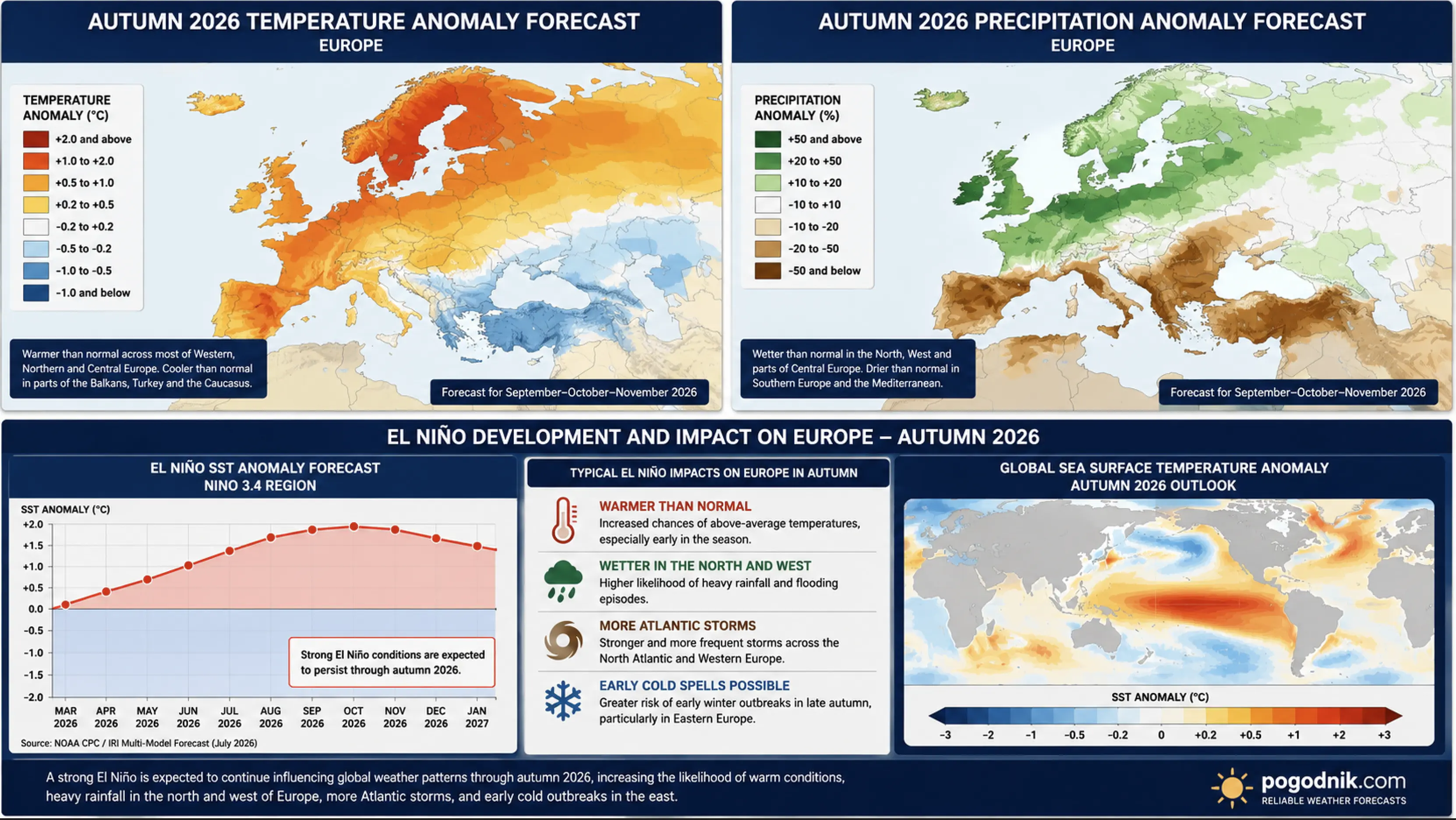
While Europe is dealing with a heat dome, North America is entering a different but connected phase of the 2026 global weather pattern. Severe Weather Europe reported that early El Niño impacts are now detectable in the atmosphere, with pressure and temperature patterns beginning to reflect the developing warm phase in the equatorial Pacific.
The early June pattern highlighted by Severe Weather Europe shows high pressure over the northern United States and a lower-pressure tendency over eastern Canada and the eastern United States. This setup supports a split summer signal: normal or below-normal temperatures in parts of eastern Canada and the eastern United States, but above-normal temperatures across the west-central United States, the Pacific Northwest and southwestern Canada.
That matters because the same type of high-pressure dominance that produces heat domes in Europe can also support dangerous heat and dry conditions in western North America. If below-normal rainfall combines with above-normal temperatures, wildfire risk, water demand and heat stress can rise quickly.
Why a heat dome becomes so dangerous
A heat dome is dangerous because it works on several levels at once. First, it raises daytime temperatures. Second, it can suppress clouds and rainfall, drying the ground and making the next day even hotter. Third, it can reduce wind and trap polluted air in urban areas. Fourth, it can keep nights warm, preventing people and buildings from cooling down.
Heat-dome mechanism
Weather effect
Human impact
Persistent high pressure
Clear skies, sinking air and reduced storm activity
Rapid heating and higher risk of prolonged heat stress
Hot air mass from lower latitudes
Sharp temperature rise over several days
Sudden heat exposure before people are acclimatised
Drying soils
Less evaporative cooling from land surface
Hotter afternoons and higher agricultural stress
Warm nights
Limited overnight recovery
Higher risk for vulnerable groups and people without cooling
Urban heat island
Cities stay hotter than rural areas
Greater pressure on hospitals, transport, energy systems and residents
Who is most at risk during this heatwave?
The most vulnerable groups include older people, infants and young children, pregnant women, people with heart or respiratory conditions, outdoor workers, homeless people, people living in poorly insulated homes, and residents without access to cooling. Tourists are also at risk when they underestimate early-season heat, especially in cities such as Paris, Rome, Madrid, Lisbon, London and Florence.
Heat is particularly dangerous because it can look less dramatic than storms, floods or wildfires. There may be no visible damage at first, but the health impact can rise silently through dehydration, heat exhaustion, heat stroke and cardiovascular stress.
Practical advice during extreme heat
Situation
What to do
Why it matters
During the hottest hours
Avoid heavy outdoor work between late morning and early evening when possible.
This reduces the risk of heat exhaustion and heat stroke.
At home
Keep curtains closed on the sunny side, ventilate at night and reduce indoor heat sources.
Indoor heat can remain dangerous even after sunset.
For outdoor workers
Use shade breaks, drink water regularly and watch for dizziness, confusion or nausea.
Heat illness can develop quickly in direct sun.
For older people
Check in by phone or in person, especially during warm nights.
Many heat-related deaths happen among people living alone.
For travel
Carry water, avoid long queues in direct sun and adjust sightseeing to morning or evening.
Tourists often underestimate local heat risk.
For pets
Never leave animals in cars and avoid walking dogs on hot pavement.
Road surfaces can become dangerously hot.
What this means for summer 2026
The late-May heatwave does not mean every day of summer 2026 will be extreme. But it does show that the atmosphere is already capable of producing high-impact heat events before the traditional summer peak. If similar blocking patterns return in June, July or August, Europe could face repeated waves of dangerous heat, especially in Western, Central and Southern Europe.
For North America, the developing El Niño signal adds another layer. The western and central United States, the Pacific Northwest and western Canada may be more exposed to above-normal temperatures under high-pressure dominance, while eastern Canada and the eastern United States may see more variability under lower pressure and northerly flow. The exact outcome will depend on the position of the jet stream, soil moisture, ocean temperatures and regional storm tracks.
FAQ: Europe heatwave and global heat risks in 2026
What caused the May 2026 heatwave in Europe?
The main cause was a strong heat dome: a persistent high-pressure system that trapped a hot air mass over Western and Central Europe. The air mass was supported by heat advected northward from North Africa.
Which countries broke heat records?
Severe Weather Europe reported major or national May heat records in several countries and regions, including England, Ireland, Wales, Portugal, France, Spain, Austria and Slovenia, with high temperatures also reported across Italy.
Why is early-season heat dangerous?
Early-season heat is dangerous because people and infrastructure are often not yet adapted to summer extremes. Warm nights, urban heat islands and lack of acclimatisation can make health impacts worse.
Is this heatwave linked to climate change?
Individual heatwaves require formal attribution studies, but the broader trend is clear: Europe is warming rapidly, and extreme heat events are becoming more frequent, more intense and more dangerous in a warmer climate.
What is the global heat picture?
Europe is experiencing an exceptional early heat dome, India has faced 45°C heat in Delhi, and North America is beginning to show early atmospheric signals from a developing El Niño pattern that may influence summer temperature and rainfall distribution.
Could more heatwaves hit Europe this summer?
Yes. If blocking highs return over Western, Central or Southern Europe during June, July or August, further heatwaves are possible. The biggest risks are prolonged heat, warm nights, drought stress, wildfire danger and health impacts in cities.
The Founder and Chief Meteorologist at Pogodnik.com. With over 15 years of operational experience in synoptic analysis and climate forecasting, he specializes in storm tracking, magnetic storms, and atmospheric dynamics. A recognized expert in Ukraine’s meteorological sector, he maintains strategic collaborations with global agencies, including NOAA and ECMWF, to ensure high-precision data integration. His analytical reviews and scientific contributions are regularly featured in leading media outlets dedicated to weather science and environmental trends.