South Korea Devastated by Record Rainfall: Two Dead, Over 1,000 Evacuated
South Korea faced a catastrophic deluge on July 16–17, 2025, as torrential rains unleashed unprecedented flooding and landslides, particularly in South Chungcheong Province, claiming at least two lives and forcing over 1,000 residents to evacuate. Seosan recorded its highest hourly rainfall in 120 years, with 114.9 mm (4.52 inches) falling in a single hour, triggering widespread chaos. As the Korea Meteorological Administration (KMA) warns of more heavy rain through Friday, the nation grapples with submerged roads, damaged infrastructure, and heightened landslide risks, marking one of the most severe weather events in its modern history.
A relentless monsoon front battered South Korea on July 16 and 17, 2025, delivering record-breaking rainfall that submerged cities, triggered landslides, and claimed at least two lives. South Chungcheong Province, south of Seoul, bore the brunt, with Seosan recording an unprecedented 114.9 mm of rain per hour, the highest since records began in 1904. Over 400 mm (15.7 inches) of rain fell in parts of the province, forcing over 1,000 evacuations and causing widespread property damage. The KMA has issued urgent warnings for continued heavy rain, landslides, and flooding, with Gwangju, Seoul, and other regions also facing significant impacts. The tragic loss of life, including a man swept away in his car in Seosan, underscores the severity of this historic weather event.
Geography of the Storm
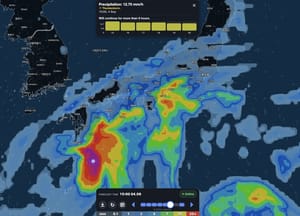
The extreme rainfall event originated from a powerful low-pressure system over the Yellow Sea, fueled by a collision of cold northwestern air and warm, moist southwesterly winds from the North Pacific. The heaviest impacts were felt in South Chungcheong Province, particularly in Seosan, Hongseong, Dangjin, Asan, and Taean, where cumulative rainfall exceeded 400 mm in some areas by July 17. Gwangju, 267 km south of Seoul, saw rapid flooding, while Seoul, Gyeonggi, and North Chungcheong provinces faced significant rainfall and disruptions. The system’s rain bands extended across South Korea, affecting North Jeolla, South Jeolla, Busan, Ulsan, and Jeju Island. The storm’s trajectory is expected to continue impacting central and southern regions through Friday, with potential effects spreading to Gangwon Province.
Meteorological Characteristics
The monsoon system driving the deluge was characterized by intense atmospheric instability, with rainfall rates in Seosan peaking at 114.9 mm per hour between 01:46 and 02:46 LT on July 17, a record for July since 1968. By 10:30 LT, Seosan had accumulated 419.5 mm (16.51 inches), Hongseong 411 mm, Dangjin 376.5 mm, and Asan 349.5 mm, representing up to 35% of the region’s annual rainfall in just two days. Central pressure estimates for the low-pressure system were approximately 990–995 hPa, driving sustained winds of 10–15 m/s (36–54 km/h) in affected areas. The KMA reported three-hour cumulative rainfall exceeding 90 mm in multiple locations, triggering 26 emergency alerts nationwide. The saturated soil, combined with ongoing rain, heightened landslide risks across Chungcheong and Gyeonggi provinces.
Forecast and Dynamics
The KMA forecasts continued heavy rainfall through Saturday, July 19, with southern Gyeonggi expecting up to 80 mm per hour and Seoul, Incheon, and northern Gyeonggi anticipating 30–50 mm per hour. South Chungcheong and Gangwon may see similar intensities into early Friday, while southern regions like Busan, Ulsan, and South Jeolla could receive 100–200 mm by Saturday. The low-pressure system is expected to weaken as it moves eastward, but saturated soils increase the risk of landslides even in areas with moderate rainfall. Numerical models (ECMWF, GFS) suggest the system will linger over the Korean Peninsula through Friday, with a potential shift toward lighter showers by Saturday. The KMA emphasizes vigilance due to the system’s erratic behavior and the risk of flash flooding.
Potential Impacts
The record rainfall caused devastating impacts across South Korea. In Seosan, a man in his 50s died after his car was swept away by floodwaters, with his final call to his wife reporting the vehicle being carried off. Another fatality occurred in Osan, Gyeonggi Province, where a 10-meter retaining wall collapsed, crushing a vehicle and killing a man in his 40s. Over 1,070 residents were evacuated, with 79 households in South Chungcheong temporarily displaced. In Gwangju, 87 roads and 38 buildings were submerged within two hours of torrential rain warnings. Landslides in Cheongyang trapped two residents, who were rescued with leg injuries. The Ministry of Education reported 403 school closures and 166 schools with property damage, primarily in Yesan and Hongseong. Infrastructure damage included flooded underpasses, closed riverside roads, and suspended train services on the Gyeongbu, Janghang, and Seohae lines. Economic losses are estimated in the billions of won, with agriculture and businesses heavily affected.
Recommendations and Warnings
The KMA has issued heavy rain and landslide alerts at the highest “serious” level for South and North Chungcheong, parts of Gyeonggi, and other central regions, urging residents to avoid underground roads, streams, and flood-prone areas, especially at night. The Korea Forest Service advises immediate evacuation for those near vulnerable slopes or rivers. Residents are recommended to prepare emergency kits with food, water, and flashlights, and to secure vehicles away from low-lying areas. The Ministry of the Interior and Safety has restricted access to 80 underpasses and low-lying bridges in Chungcheong. Emergency text alerts, triggered when hourly rainfall exceeds 50 mm or three-hour totals surpass 90 mm, are being sent via mobile networks. For updates, residents should monitor KMA’s website, Yonhap News, or contact emergency services at 119.
Historical Context
South Korea’s summer monsoon season typically brings heavy rains in July, but the 2025 event stands out as the most intense in 120 years, surpassing records set in 1904. Seosan’s 114.9 mm per hour is a once-in-a-century event, and the region’s 400+ mm in two days is unprecedented. Previous severe flooding in 2022 killed 11 in Seoul, including three in a semi-basement apartment, prompting bans on such housing. In 2023, 40 people died in floods and landslides, including 13 in a flooded tunnel in Cheongju, North Chungcheong. The current event’s high rainfall rates and widespread impacts echo these disasters, with scientists attributing increased intensity to climate change, as warmer air holds more moisture, fueling extreme precipitation.
Conclusion
The record-breaking rainfall in South Korea on July 16–17, 2025, has left a trail of destruction, with at least two deaths, over 1,000 evacuations, and extensive damage to infrastructure and schools. South Chungcheong Province, hit by 419.5 mm of rain in Seosan, faces ongoing risks of flooding and landslides as more rain is forecast through Saturday. The KMA and local authorities urge residents to stay vigilant, avoid hazardous areas, and follow updates, with the next KMA bulletin expected at 12:00 LT on July 18. This historic monsoon event highlights the growing threat of extreme weather, likely exacerbated by climate change, and underscores the need for enhanced preparedness. Stay safe and monitor official channels for real-time guidance.
Sources
Korea Meteorological Administration (KMA): Real-time weather updates and warnings.
Ministry of the Interior and Safety: Evacuation and safety reports.
Yonhap News Agency: Regional impact coverage.
The Watchers: Detailed storm analysis.
Reuters: Flooding and casualty reports.
The Independent: Landslide and evacuation details.
The Founder and Chief Meteorologist at Pogodnik.com. With over 15 years of operational experience in synoptic analysis and climate forecasting, he specializes in storm tracking, magnetic storms, and atmospheric dynamics. A recognized expert in Ukraine’s meteorological sector, he maintains strategic collaborations with global agencies, including NOAA and ECMWF, to ensure high-precision data integration. His analytical reviews and scientific contributions are regularly featured in leading media outlets dedicated to weather science and environmental trends.