Typhoon Fung-Wong Heading for Taiwan and Hong Kong — Latest Track and Forecast

Current status and intensification
According to the latest meteorological data, Fung-Wong is now a well-organized tropical cyclone in the western Pacific with a steady west-northwest drift.
The storm is fueled by exceptionally warm sea-surface temperatures (29–30 °C), high ocean heat content, and favorable upper-level outflow with minimal vertical wind shear — a perfect recipe for strengthening before entering the Luzon Strait.
Spaghetti models and Windy forecast
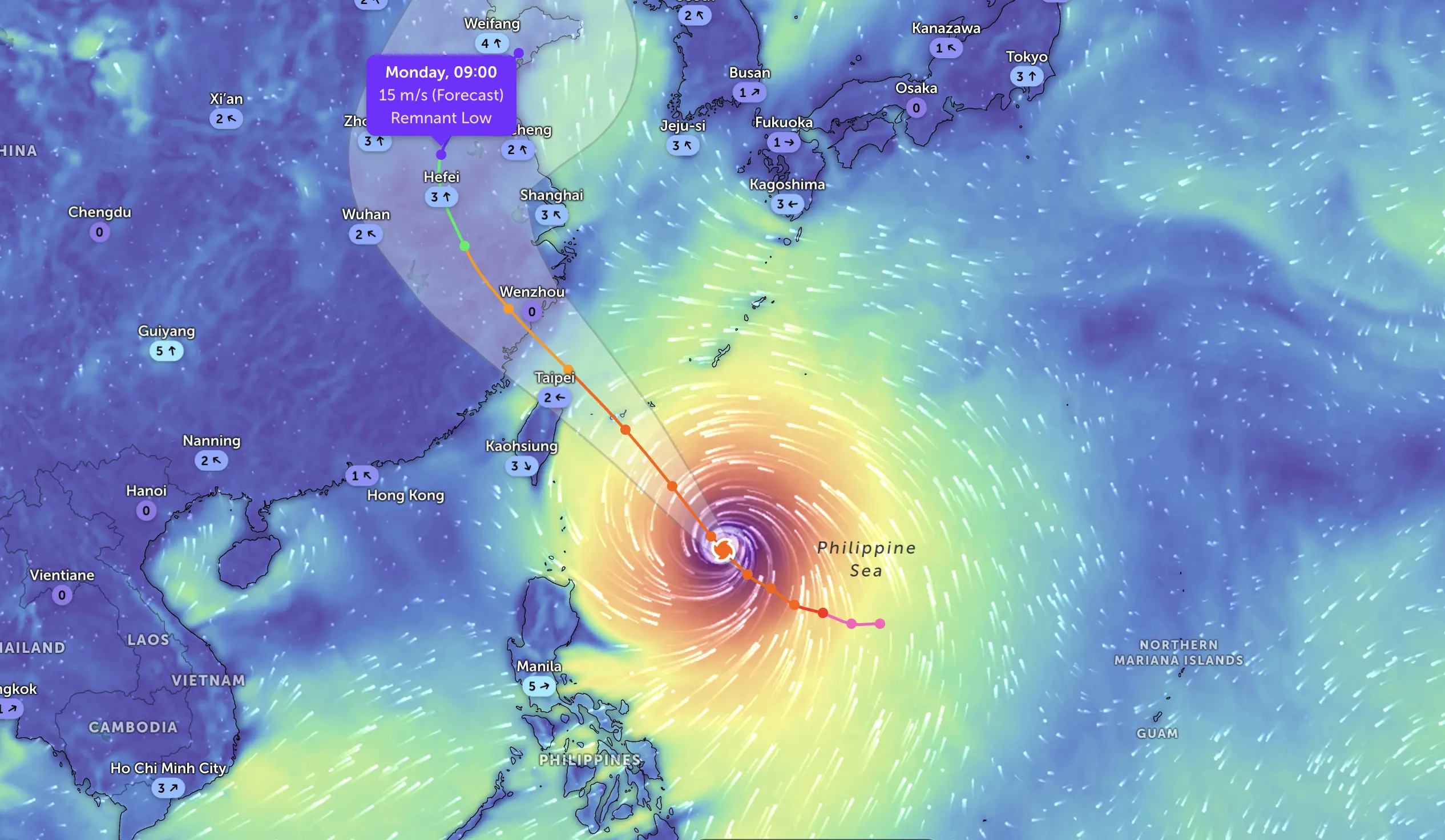
The ensemble “spaghetti” models (GFS, ECMWF, HAFS, ICON) converge along a common arc: eastern northern Luzon → Luzon Strait → north-northwest toward Taiwan, eventually curving into the northern South China Sea.
On Windy visualizations, this appears as a dense core track with a wide cone of uncertainty spanning southern Taiwan, the Babuyan Islands, and the maritime sector between Hong Kong and southern Taiwan.
Two primary forecast scenarios are in play:
Scenario A (northern track): Crossing the Luzon Strait near southern Taiwan, then bending west-northwest toward Guangdong and the Pearl River Delta — increasing risks for Taiwan, marine operations, and the Taiwan Strait shipping corridor.
Scenario B (southern track): Skimming northern Luzon and emerging into the northern South China Sea toward waters south of Hong Kong and north of Hainan. This outcome prolongs marine hazards for Guangdong and northern Vietnam with stronger wave action and coastal flooding.
Track divergence remains small until Luzon but expands after entering the South China Sea due to competition between the subtropical ridge and an advancing continental air mass. Small shifts can redefine the impact area, so forecasts will be updated every 6–12 hours.
Regional timeline: when and where
Northern Philippines (northern Luzon, Babuyan Islands): The first heavy rainbands and gusts will arrive 12–24 hours before the core; mountain slopes face flash-flood and landslide risks. Coastal waves will grow rapidly.
Luzon Strait and southern Taiwan (Kaohsiung, Pingtung): Typhoon-force winds and heavy rain likely within 24–48 hours after the system crosses northern Luzon. Rough seas and high surf expected.
Hong Kong, Shenzhen, Guangdong coast: Under the northern scenario, expect storm-force winds, torrential rain, and coastal inundation 2–3 days after the system leaves the Luzon Strait. Peak gusts possible in open coastal areas.
Hainan: Coastal squalls and heavy showers possible as the typhoon skirts the northern South China Sea; rough seas will persist.
Northern Vietnam (Gulf of Tonkin): Direct landfall is less likely, but secondary effects — long-period swells, storm surge, and scattered rainbands — remain possible through the week.
Key hazards
- Wind: Typhoon-strength gusts near the core; local acceleration in mountain passes and exposed coasts.
- Rain and floods: 200–300 mm possible on windward slopes of northern Luzon and southern Taiwan; landslides expected.
- Storm surge and coastal flooding: Rapid water-level rise in bays and inlets; erosion and infrastructure damage possible.
- Marine conditions: Extremely rough seas with wave heights 6–8 m; port closures and ferry suspensions expected.
Preparedness tips
- Plan two fallback options for both northern and southern track shifts; even indirect passes bring flooding and dangerous seas.
- Secure outdoor objects and check drainage; reinforce windows and signage.
- Mariners should remain in port — avoid sailing between rainbands.
- Mountain communities should prepare for road closures and possible evacuations due to landslides.
Outlook and conclusion
Most forecast models agree that Fung-Wong will pass near the northern Philippines and cross into the Luzon Strait before influencing Taiwan, Hong Kong, and the southern Chinese coastline from Guangdong to Hainan.
Even without a direct landfall, the combination of strong winds, torrential rain, and storm surge poses a high threat to coastal infrastructure and maritime transport.
Track and intensity updates will be issued every 6–12 hours — stay tuned to official advisories.
Frequently Asked Questions
Will Typhoon Fung-Wong directly hit Hong Kong?
It depends on the post-Luzon turn. Even if the core remains offshore, Hong Kong may experience storm-force gusts, heavy rain, and coastal flooding.
When will southern Taiwan face the worst weather?
Roughly 24–48 hours after the system clears northern Luzon — expect severe squalls, intense rainfall, and large waves from the southeast.