Snow in Europe and Storm Konrad in Spain

Europe has seen a variety of weather conditions, from heavy snowfalls in the mountains to stormy rains in Spain – Storm Conrad. Meteorologists are warning of significant precipitation in the Alps, with Austria, Switzerland and northern Italy bracing for snowfalls, especially in the Milan and Venice areas. Snow is also expected in cities such as Vienna and Zurich, although in the lowlands it could turn into sleet or rain at temperatures around +1…+3°C.
The Balkan Mountains, including the Dinaric Alps in Croatia and Bosnia, will also see snow, with up to 10–15 cm in the Sarajevo area. Up to 10–20 cm of snow is forecast in Slovakia and the Carpathians (Ukraine, Romania), which could complicate transport links.
Northern Italy under attack
Intense precipitation is expected in northern Italy, especially around Venice. In the Dolomites, snow will be heavy, but in Venice itself, where temperatures will be +5…+7°C, precipitation will turn into heavy rain, increasing the risk of local flooding.

Storm Conrad – Spain battles bad weather
While the mountainous regions are blanketed in snow, Spain is facing Storm Conrad, a powerful low-atmospheric system bringing heavy rain and winds to the Balearic Islands and the southern coast. According to meteorologists, the Balearic Islands have already received up to 20-30 mm of rain, which has led to flooding and transport disruptions, including flight cancellations and road closures. Intense rain is expected in the Malaga area, creating a risk of flash floods and landslides. The Spanish meteorological service AEMET calls on residents to be vigilant and follow safety recommendations.

Weather in other regions
In other parts of Europe, conditions are also varied: in France (Lyon, Bordeaux) there is rain at temperatures of +6…+10°C, excluding snow. In the UK and Ireland, heavy rain and strong winds are expected with the possibility of flooding on the coast. In eastern Europe, for example in Poland and the Czech Republic, snow is possible in highland areas, while in the plains there is rain or mixed precipitation.
Residents of Europe are urged to monitor local forecasts and follow safety measures. In mountainous areas, avoid unnecessary travel, especially without winter tires. In areas with heavy rain and storms, stay away from flooded areas and follow government evacuation orders if necessary.
Heavy rainfall is forecast for the Balearic Islands (Palma), Venice, southern Spain (Malaga) and the central Mediterranean.
Snowfall details
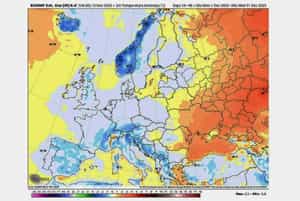
Alps: Up to 20-30 cm of snow is expected in Austria, Switzerland and northern Italy, especially in the Italian Alps. This is confirmed by the map, which shows heavy rainfall in the Milan and Venice area, turning into snow in the mountainous areas.
Balkans: Snowfall is forecast in the Dinaric Alps (Croatia, Bosnia) – up to 10-15 cm, which corresponds to the light blue areas on the map.
Slovakia and Carpathians: Up to 10-20 cm of snow is expected in the Tatras and Carpathians (Ukraine, Romania), although the map does not cover these regions, the forecast is based on typical March conditions.
People in mountainous regions are advised to avoid travelling without winter tyres, and in storm zones such as Spain, to monitor flood warnings. This forecast highlights the contrast in weather conditions across Europe: snow in the northern and mountainous regions versus rain and storms in the south, which requires flexibility in planning and preparation for extreme events.
March 2025 Celestial Events: Lunar Eclipse, Equinox, and Solar Eclipse

Gleb Perov is the founder and chief meteorologist of POGODNIK, a leading weather forecasting service in Eastern Europe. With over 15 years of hands-on experience in meteorology and climate analysis, he has worked private weather services.
Gleb is the author of numerous scientific and analytical publications on climate, magnetic storms, and atmospheric processes. He regularly collaborates with major international agencies such as NOAA, ECMWF.