Catastrophic Storms Devastate Austin: One Dead, Thousands in Darkness
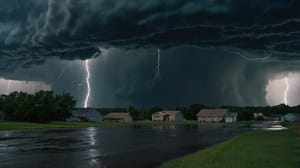
The heart of Texas was torn apart on the evening of May 28, 2025, as a ferocious storm system unleashed its wrath upon Austin, leaving a trail of destruction, despair, and one tragic loss of life. The skies turned apocalyptic, with howling winds, torrential rains, and hailstones the size of baseballs pummeling the city. Flash floods swallowed streets, trees crashed through homes, and power lines snapped like twigs, plunging tens of thousands into darkness. As emergency crews battled through the chaos, one soul was lost to the rising waters—a grim reminder of nature’s unrelenting power.
— Falcon Storm Chasing (@FalcnStormChase) May 28, 2025
Austin Under Siege
The storm descended on Austin with little warning, transforming a tranquil evening into a scene of pandemonium. Between 18:45 and 19:00, the National Weather Service in Austin/San Antonio recorded wind gusts tearing through the city at a staggering 124 km/h (77 mph). Rain gauges overflowed, capturing 51–76 mm (2–3 inches) of rain in just 30 minutes, with some areas drowning under 75–105 mm (3–4 inches) of water. Hailstones, some as large as 7 cm (2.75 inches), battered homes, cars, and businesses, leaving a wake of shattered glass and dented dreams.
The deluge turned Austin’s streets into raging rivers. Flash flooding trapped motorists in their vehicles, with water rising faster than anyone could have anticipated. Fire crews, stretched to their limits, responded to nine flood-related emergencies, pulling stranded residents from cars and homes as the waters surged. On 49th Street, tragedy struck: one person, reported missing amid the chaos, was found lifeless, claimed by the merciless floodwaters. The Austin Fire Department confirmed that all other individuals involved in flood-related incidents have been accounted for, but the loss of life cast a somber shadow over the city.
A Landscape of Destruction
The storm’s fury spared little. In Northwest Austin, a gas station canopy was ripped from its moorings, crashing onto a parked car in a twisted heap of metal. At the University of Texas, high winds tore down fencing around the baseball field, scattering debris across the campus. Downtown, the Texas Capitol rotunda—symbol of the state’s resilience—suffered as glass panels near its summit shattered under the storm’s relentless assault.
Homes across the city bore the brunt of the onslaught. In the north and east, hail punctured roofs, obliterated skylights, and ripped siding from buildings. Vehicles, caught in the open, were left with cracked windshields and pockmarked bodies, their owners reeling from the sudden devastation. Trees, some decades old, were uprooted or snapped in half, crashing onto power lines and homes. Austin Energy reported over 100 power poles toppled, leaving nearly 70,000 customers—30,000 in Travis County alone—without electricity well into Thursday morning, May 29.
The Austin-Travis County Emergency Medical Services were overwhelmed, with Chief Robert Luckritz reporting a 35 percent spike in 911 calls during the storm’s peak. The Fire Department fielded over 700 calls in just a few hours, a testament to the scale of the crisis. “It was like the city was under attack,” one firefighter recounted, his voice heavy with exhaustion. “We were racing from one emergency to the next, trying to keep up with the storm’s destruction.”
A Community in Crisis
As the storm subsided, Austin awoke to a landscape transformed by chaos. Flooded roads remained impassable in many areas, forcing residents to navigate a maze of debris and downed power lines. Schools canceled classes, businesses shuttered, and families huddled in darkened homes, waiting for power to be restored. For many, the loss was more than material—roofs could be repaired, cars replaced, but the emotional toll of the storm lingered like a bruise.
Lauren Petterson, a local resident, captured the flooding’s intensity in a haunting photograph that has since gone viral. The image, showing a street transformed into a churning river, serves as a stark reminder of the night Austin was brought to its knees. “I’ve never seen anything like it,” Petterson said. “The water came so fast, it was like the city was sinking.”
The National Weather Service warned that the conditions leading to this disaster were not an anomaly. Texas, long accustomed to extreme weather, faces increasing risks as climate patterns shift. Meteorologists pointed to the storm’s rapid intensification—fueled by warm, moist air clashing with powerful atmospheric dynamics—as a sign of things to come. “This is a wake-up call,” said Dr. Emily Suarez, a climatologist at the University of Texas. “Storms like these are becoming more frequent and more severe. Austin needs to prepare for a future where these events are no longer rare.”
Heroes Amid the Havoc
Amid the devastation, stories of heroism emerged. Firefighters waded through chest-deep water to rescue a family trapped in their home in East Austin. Paramedics braved fallen trees and live wires to reach a motorist stranded on a flooded overpass. Neighbors banded together, checking on the elderly and sharing supplies with those who had lost everything. In a city known for its vibrant spirit, Austinites showed their resilience, even as they mourned.
Yet, the challenges ahead are daunting. Austin Energy crews worked around the clock to restore power, but officials warned that some areas could remain without electricity for days. The cost of repairs—to homes, businesses, and infrastructure—is expected to run into the millions. For small business owners, already battered by economic uncertainties, the storm’s damage could be a death knell. “My shop’s roof is gone,” said Maria Gonzalez, owner of a small boutique in North Austin. “I don’t know how we’ll recover from this.”
As Austin begins the long process of rebuilding, questions loom about how to prepare for the next inevitable storm. City officials have promised to review infrastructure vulnerabilities, particularly the aging power grid and drainage systems that buckled under the deluge. Community leaders are calling for stronger emergency response plans and better public awareness of flood risks. “We can’t keep reacting after the fact,” said Councilwoman Vanessa Rivera. “We need to act now to protect our city and our people.”
For the family of the individual lost on 49th Street, no amount of preparation can undo their grief. Their loss serves as a heartbreaking reminder of the stakes in a world where nature’s fury is growing ever more unpredictable. As Austin mourns, it also looks forward, determined to rise from the wreckage stronger than before.
The storm of May 28, 2025, will be etched in Austin’s memory—a night when the skies roared, the waters rose, and a city was tested to its core. Yet, in the face of tragedy, Austin’s spirit endures, a beacon of hope amid the darkness.
The Founder and Chief Meteorologist at Pogodnik.com. With over 15 years of operational experience in synoptic analysis and climate forecasting, he specializes in storm tracking, magnetic storms, and atmospheric dynamics. A recognized expert in Ukraine’s meteorological sector, he maintains strategic collaborations with global agencies, including NOAA and ECMWF, to ensure high-precision data integration. His analytical reviews and scientific contributions are regularly featured in leading media outlets dedicated to weather science and environmental trends.