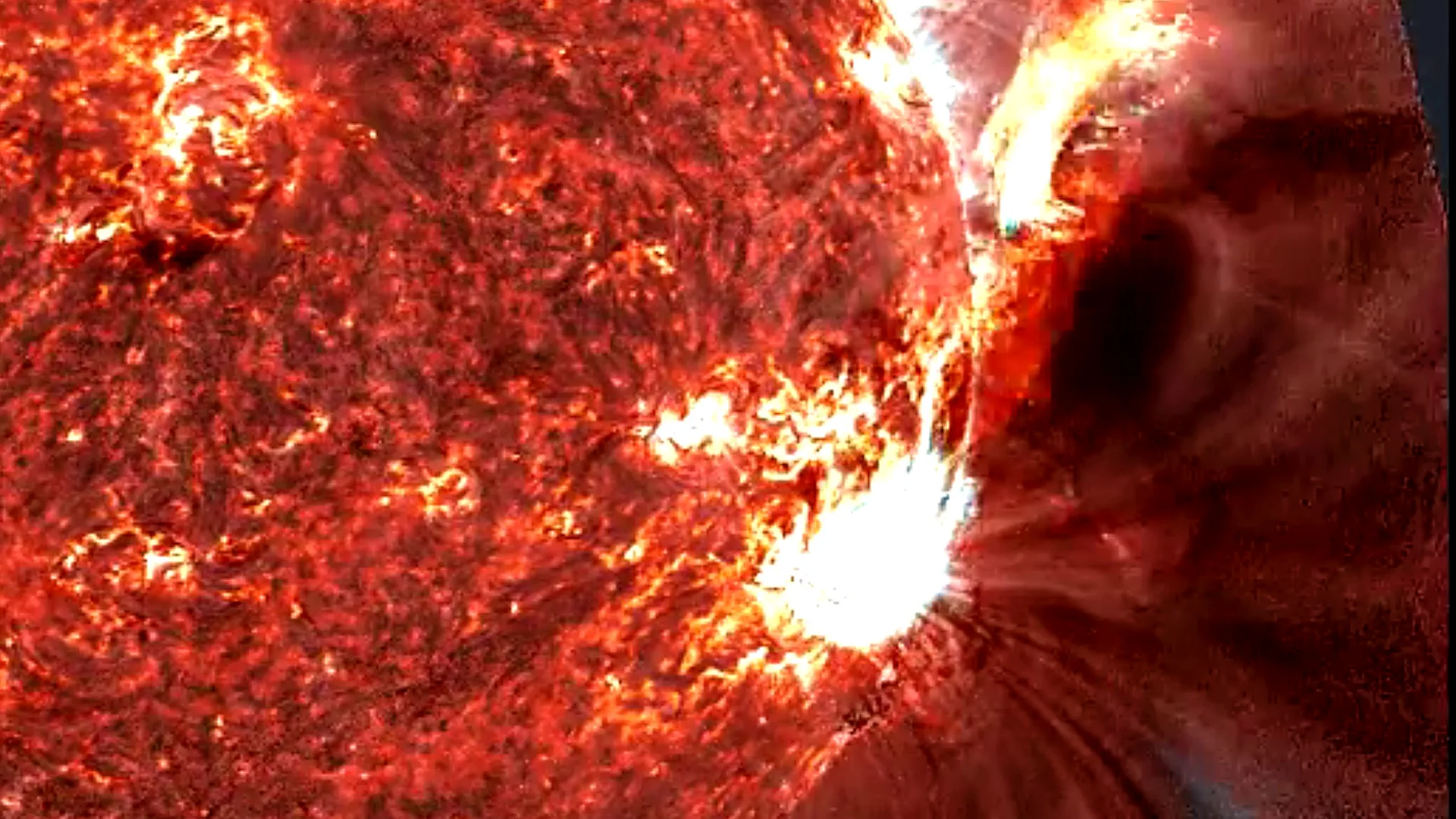
Magnetic storm today – a magnetic storm will hit the Earth on August 8-9

Our planet is preparing to meet another space “hurricane“. On August 8-9, 2025, the Earth will be hit by a moderate magnetic storm of level G2, which can seriously affect the technological infrastructure and the well-being of millions of people. The cause of this phenomenon was a coronal mass ejection (CME) associated with a powerful solar flare of class M4.4, which occurred on August 5 at 15:53 UTC.

Causes of the impending magnetic storm
Solar activity in August 2025
The fourth powerful flare in August occurred on the Sun, indicating a significant increase in solar activity this month. The current period is characterized by the approach to the peak of the 25th solar cycle, which will reach its maximum in 2025.
The main “culprit” of the upcoming geomagnetic disturbances was the active region 4168 on the surface of the Sun. It was from this region that the M4.4 solar flare occurred on August 5 — powerful enough to generate a coronal mass ejection directed toward Earth.

The mechanism of magnetic storm formation
A coronal mass ejection is a giant cloud of magnetized plasma that moves through interplanetary space at a speed of about 500-800 kilometers per second.
In the case of a coronal mass ejection from the Sun, stellar matter moves toward us over an average of three days. This is why the flare on August 5 will reach our planet on August 8.
The peculiarity of the upcoming event is that the CME will be accompanied by a corotating interaction region (CIR) – a solar wind structure formed at the boundary of fast and slow plasma flows from the coronal hole in the southern hemisphere of the Sun. This double effect will significantly increase geomagnetic disturbances.
Recent events on the Sun
Over the past 24 hours, 15 flares occurred on the Sun, which demonstrates the high level of activity of our luminary. Most of them were weak (class C), but the cumulative effect of multiple disturbances creates favorable conditions for increasing geomagnetic activity.
Active region 4168 continues to be a source of increased danger. According to experts, the probability of M-class flares is 55%, and X-class – 10% in the period up to August 9. This means that in addition to the CME already heading towards us, additional disturbances are possible.
Geomagnetic Activity Forecast
A G2 (moderate) magnetic storm is expected in the first half of August 8, 2025, with a continuation of the impact until August 9 at the G1 (weak) level. Peak values of the geomagnetic index Kp can reach 6 units, which corresponds to noticeable disturbances in the Earth’s magnetic field.
The solar flux index F10.7 is predicted at 155 units, indicating an increased level of solar activity. The average daily Ap index is expected at 8 units, which exceeds calm conditions by more than twice.
Geographical distribution of effects
The strongest impacts are expected in high-latitude regions – north of 55° geomagnetic latitude. This means that residents of Alaska, northern Canada, Scandinavia, northern regions of Russia and Greenland will feel the maximum effects of the storm.
Auroras can be observed much further south than usual — up to the latitudes of New York, Wisconsin, and Washington State in the United States, and in Russia — up to the latitudes of St. Petersburg and Yekaterinburg.
Impact on technology and infrastructure
Power systems
Moderate G2 magnetic storms can cause fluctuations in power grids, especially in high-latitude power systems. Activation of protective systems and voltage alarms is possible. Power grid operators in northern regions should be prepared for possible interruptions and have backup capacity.
Satellite systems
Satellites in low Earth orbits will face increased atmospheric drag due to heating of the upper atmosphere. This can lead to accelerated orbital decline and the need to correct trajectories. Disorientation of satellites and failures in the operation of onboard systems are possible.
Radio Communications
High frequency (HF) radio communications at high latitudes may experience significant disruptions. Transpolar flights will be particularly affected and may need to be rerouted to maintain and communication with control services.
Navigation systems
GPS and other satellite navigation systems may demonstrate reduced accuracy, especially in polar and subpolar regions. Positioning errors of up to several meters are possible.
Impact on human health
Meteorological sensitivity
Magnetic storms occur on Earth constantly, and they can be predicted several days in advance, which allows weather-sensitive people to prepare for an unfavorable period. About 15-20% of the population experiences various symptoms during geomagnetic disturbances.
Main symptoms
The most common manifestations of the impact of magnetic storms on the human body are:
- Headaches and migraines
- Increased fatigue and weakness
- Sleep disorders and insomnia
- Blood pressure surges
- Exacerbation of chronic diseases
- Increased irritability and anxiety
- Heart rhythm disturbances
Risk groups
People with cardiovascular diseases, hypertension, weather sensitivity, as well as the elderly and children are at particular risk. Pilots and crews of high-altitude flights are also at increased risk due to increased exposure to cosmic radiation.
Methods of protection and recommendations for weather-sensitive people
General recommendations:
- Avoid increased physical and emotional stress
- Maintain a regular sleep schedule
- Increase water intake
- Limit alcohol and caffeine consumption
- Spend more time outdoors
For weather-sensitive people:
- Have the necessary medications on hand
- Measure blood pressure more often than usual
- Avoid long trips and flights
- Practice relaxation techniques
- Consult a doctor if your condition worsens
Peak of the solar cycle
The peak of solar activity will only increase until 2025, which means that the upcoming storm is just a harbinger of more powerful geomagnetic disturbances. The 25th solar cycle will reach its maximum in mid- to late 2025, so humanity must prepare for more frequent and more intense magnetic storms.
Technological adaptation
The events of August 2025 highlight the importance of developing space weather as a science and the need to create technological systems that are more resilient to geomagnetic disturbances. Investments in forecasting and protection systems are becoming critical for modern society.
Conclusion
The magnetic storm of August 8-9, 2025 will be a serious test for technological infrastructure and another reminder of the power of space processes. Although the G2 level is considered moderate, the combined effect of the CME and the corotating interaction region can enhance the effects.
The key to minimizing the negative consequences is preparedness – both at the level of organizations and enterprises, and among ordinary citizens. Modern space weather monitoring systems allow for early warning of impending disturbances, giving time to take protective measures.
The article is based on data from the NOAA Space Weather Prediction Center.
Magnetic storm calendar for August 2025
Weather app with magnetic storm forecast