Heat Dome Returns : 45°C Scorchers Set to Shatter August Records
After a brief respite from the continental furnace that dominated late July, Europe is bracing for the return of an even more formidable heat dome that will fundamentally reshape weather patterns across the continent through mid-August 2025. As a seasoned meteorological analyst with extensive experience interpreting ECMWF and ensemble model outputs, the synoptic-scale evolution unfolding represents a textbook example of persistent blocking patterns that generate extreme temperature anomalies.
Heat Dome Returns: Synoptic Analysis
The heat dome is back this week, and it will intensify across western, central, southern, and eastern Europe late this week, likely expanding into mid-August as the pattern stabilizes and an extensive ridge dominates the continent. The upper-level ridge structure, characterized by 500mb heights exceeding 588 decameters across vast swaths of central Europe, represents the primary driver behind this continental-scale thermal event.
Following the passage of Storm Floris – an unusually intense Atlantic storm that smashed into northern UK and Scotland on Monday with powerful winds around 130 km/h across the lowlands and up to 180 km/h in the Scottish Highlands – the Azores High is aggressively expanding eastward, establishing a dominant anticyclonic circulation that will trap superheated air masses beneath its influence.
Temperature Projections and Regional Breakdown
Western Europe: The Epicenter of Extremes
France emerges as ground zero for the most severe thermal stress. Peak temperatures will return to the low 40s °C over France, with temperatures reaching 40-42 °C in the south and west plains by Friday, continuing into the weekend with mid-to-upper 30s expanding into northern France and Benelux by Saturday. The Paris metropolitan area shows particularly concerning trends, with sustained temperatures 12-14°C above climatological normals for early August.
The Iberian Peninsula maintains its role as Europe’s furnace. Portugal and Spain should maintain the upper 30s to low 40s until at least the following weekend, with daily maximum temperatures ranging from 38 to 43 °C in most regions, and the most significant temperatures in central Portugal and south-southwestern Spain reaching 41-43 °C.
Central and Eastern Europe: The Eastward Migration
The most alarming development involves the heat dome’s eastward progression. By Monday, the heat dome shifts eastward with its core over central and eastern Europe, bringing temperatures 12-14 °C above average, with the highest anomalies over Hungary, Croatia, and Serbia where temperatures around 15 °C above normal are possible.
Italy and the Balkans face particularly severe conditions. Central Europe, Italy, and the Balkan countries will see a rapid increase in temperatures after Thursday, reaching 37-41 °C from Friday through Tuesday next week, with the highest temperatures potentially reaching around 43 °C over the Balkans, especially across eastern Croatia, Hungary, and Serbia.
Northern Europe: Relative Relief
Scandinavia finally experiences respite after shattering numerous temperature records in late July. Ireland and the UK will not experience significant heat this time, with temperatures over southern England pushing back into the upper 20s but 30s unlikely, while Ireland and Scotland will remain at 18-22 °C at most over the weekend.
Atmospheric Dynamics and Meteorological Mechanisms
The current pattern represents a classic omega-block configuration with extraordinary persistence. The 850mb temperature anomaly fields reveal air masses warming 8-15°C above seasonal normals, indicating subsidence-induced adiabatic heating characteristic of robust anticyclonic systems. The heat dome’s stability stems from the coupling between upper-level ridging and surface high pressure, creating a self-reinforcing feedback loop that maintains the thermal anomaly.
ECMWF ensemble spreads remain relatively tight through day 10, suggesting high confidence in the pattern’s persistence. The subtropical ridge’s strength, evidenced by 500mb heights approaching record territory for early August, indicates minimal opportunities for Atlantic intrusions to disrupt the continental heat engine.
Records and Milestones: August 2025’s Historic Context
While comprehensive record assessments require post-analysis validation, preliminary indications suggest August 2025 may challenge or exceed several notable benchmarks:
France’s all-time August temperature record (44.1°C, Carpentras, 2019) faces serious threat
The Balkans appear positioned to potentially exceed 45°C, approaching continental European records
Nighttime minima failing to drop below 25°C across extensive areas, indicating tropical night frequency records
Consecutive days above 40°C records threatened across multiple nations simultaneously
The persistence factor amplifies the significance. Unlike brief heat spikes, this event’s duration – potentially extending 10-14 days – places it among Europe’s most significant heat dome events in observational history.
Storm Systems, Convective Threats, and Hydrological Concerns
Convective Instability
Despite the dominant anticyclonic pattern, thermal instability generated by extreme surface heating creates localized severe weather threats. Afternoon convective activity along convergence boundaries may produce isolated supercells capable of large hail, particularly across the German-Polish border region where upper-level divergence intersects with boundary layer instability.
The most significant threat involves dry thunderstorms across fire-vulnerable regions. With precipitable water values dropping below the 10th percentile and surface dewpoints remaining elevated, any convective development risks producing cloud-to-ground lightning with minimal precipitation – a textbook wildfire ignition scenario.
Hydrological Impacts
Significant heat will also gradually worsen drought conditions across Iberia and Southeast Europe, where recent devastating wildfires have been ongoing. Evapotranspiration rates will approach or exceed 8mm/day across agricultural regions, rapidly depleting soil moisture reserves built during recent wet periods.
River discharge forecasts indicate concerning trends for the Danube basin, where confluence temperature readings may approach or exceed 28°C – approaching critical thresholds for aquatic ecosystems and thermal power plant cooling operations.
MeteoAlarm Status and Warning Framework
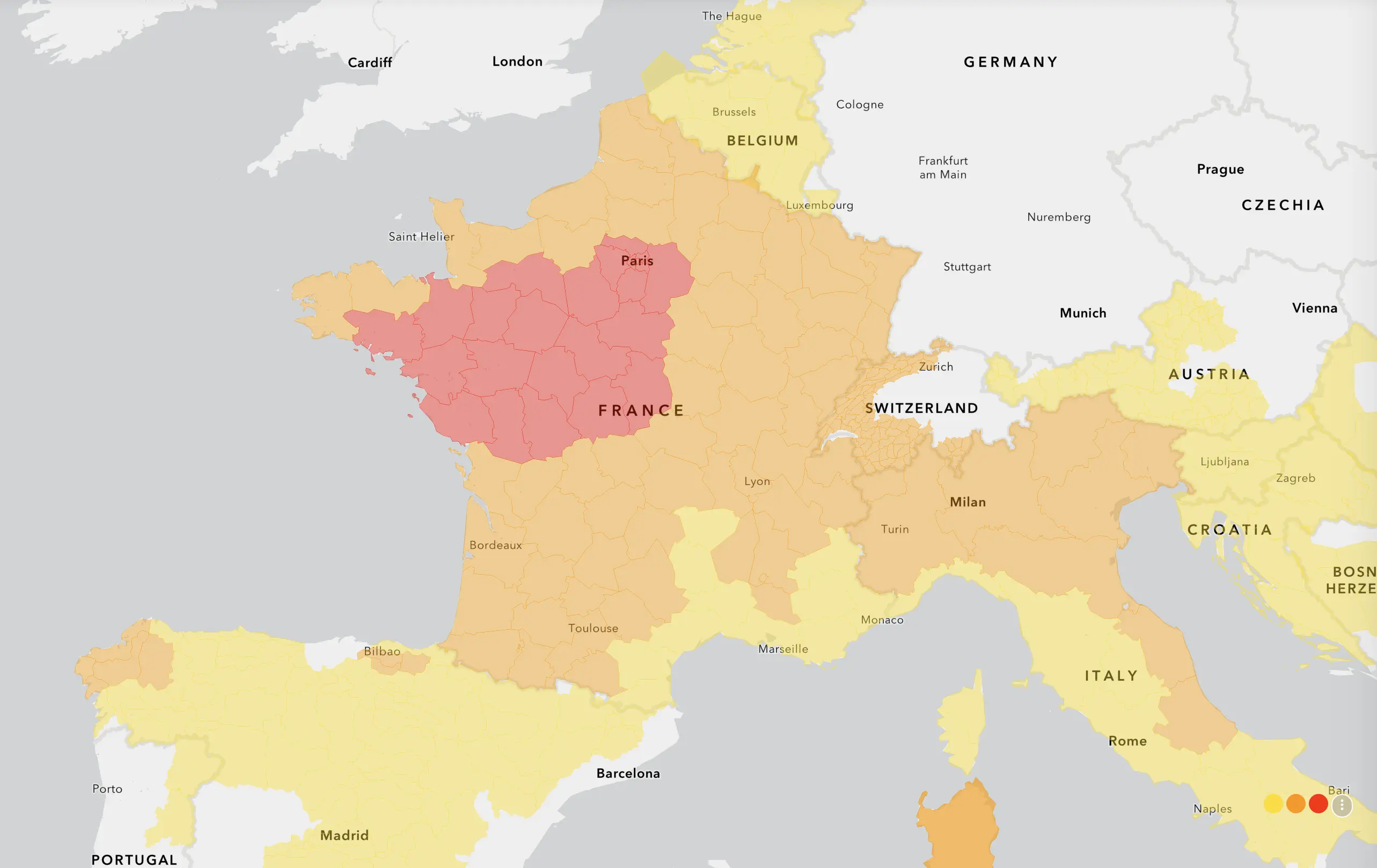
MeteoAlarm, the Early Warning Dissemination System that visualizes and aggregates awareness information from 38 European National Meteorological and Hydrological Services, shows an evolving landscape of heat warnings across the continent.
Current warning levels indicate:
Red Heat Warnings (Level 4): Expected across portions of:
Central and southern France
Northern Italy’s Po Valley
Western Balkans (Croatia, Serbia, Bosnia and Herzegovina)
Southwestern Spain and central Portugal
Orange Heat Warnings (Level 3): Covering extensive areas of:
Germany’s Rhine Valley
Eastern France
Northern Italy
Hungary and Slovakia
Southern Poland
Yellow Heat Warnings (Level 2): Encompassing:
Benelux countries
Austria and Czech Republic
Eastern Spain
Southern Germany
Fire weather warnings complement heat advisories across Iberia, southeastern France, and the Balkans, where critical fire weather indices exceed extreme thresholds.
Medium-Range Evolution and Extended Outlook
ECMWF extended-range guidance maintains remarkable consistency regarding pattern persistence. Mid-range trends suggest that the heatwave may extend into mid-August 2025, with the 850mb temperature anomaly chart hinting at more heat forecast, affecting similar areas: the Iberian Peninsula, western and central Europe, including the Balkans and Italy.
The pattern shows potential for UK involvement by mid-month, representing a significant eastward expansion of the thermal anomaly. GFS and ECMWF consensus through day 15 maintains the ridge structure, though amplitude may fluctuate.
Model ensemble clustering analysis reveals approximately 75% of members maintaining significant positive temperature anomalies through August 20th, with only 15% showing meaningful pattern breakdown before month’s end.
Wildfire and Environmental Risks
The confluence of extreme heat, low relative humidity, and antecedent drought conditions creates a volatile wildfire environment. The extreme heat will persist for days, quickly drying out the soil as the air mass becomes dry, and despite rainy periods in recent weeks, the threat of wildfires will gradually increase again.
Fine fuel moisture content models indicate critical thresholds (≤8%) across extensive areas of:
Portuguese interior mountains
Spanish Meseta Central
French Mediterranean departments
Balkan mountain ranges
Southern Italian regions
The Haines Index, measuring atmospheric stability and dryness for fire weather, approaches maximum values (6) across these regions, indicating extreme fire weather conditions.
Public Health and Societal Impact Assessment
The health meteorology implications demand urgent attention. Heat index calculations, factoring both temperature and humidity, will approach dangerous levels across urban heat islands. Metropolitan areas face particular risk:
Paris: Heat index potentially exceeding 50°C during peak afternoon hours
Rome: Extended periods above 45°C heat index
Madrid: Nighttime recovery temperatures failing to drop below 28°C
Vulnerable populations – elderly, infants, outdoor workers, and economically disadvantaged communities – face elevated heat stress risks. The duration factor amplifies danger, as consecutive hot nights prevent physiological recovery.
Agricultural and Economic Consequences
Crop stress indices will reach critical levels across Europe’s agricultural heartland. Corn silk emergence coinciding with extreme heat threatens pollination success rates. Wine grape regions face potential quality degradation from excessive thermal stress during critical ripening phases.
Energy sector impacts include:
Thermal power plant efficiency reductions due to elevated cooling water temperatures
Increased air conditioning demand stressing electrical grids
Solar panel efficiency decreases due to extreme temperatures
Wind power generation reductions in high-pressure dominated regions
The Broader Climate Context
This heat dome exemplifies the amplification of blocking patterns under changing climatic conditions. The event’s intensity and spatial extent align with climate model projections indicating increased frequency and magnitude of European heat extremes.
The pattern’s persistence, enhanced by slower jet stream dynamics and increased meridional flow characteristics, represents tangible manifestation of atmospheric circulation changes documented in recent climate research.
Forecaster Confidence and Uncertainty Analysis
Confidence remains exceptionally high for major heat event occurrence through August 15th. ECMWF ensemble spread analysis shows tight clustering around extreme solutions, indicating robust signal consistency. Statistical post-processing of raw model output confirms the event’s severity with probability-matched mean temperatures exceeding 99th percentile thresholds across affected regions.
Primary uncertainties involve:
Exact timing of peak intensity (±24-48 hours)
Specific temperature maxima at individual locations (±2-3°C)
Pattern breakdown timing and mechanisms
Convective precipitation development and fire weather interactions
A Continental-Scale Meteorological Event
The developing heat dome represents one of August’s most significant thermal events in European meteorological history. The combination of intensity, spatial extent, and duration creates unprecedented challenges across multiple sectors. Immediate preparation for extreme heat impacts remains essential, while longer-term adaptation strategies demand urgent consideration.
The pattern’s evolution through mid-August will determine whether 2025 joins the pantheon of Europe’s most memorable heat years. Current model guidance suggests this outcome appears increasingly likely, with implications extending far beyond meteorological record books into the fundamental challenge of building societal resilience against intensifying thermal extremes.
Monitoring and preparedness efforts must remain at maximum alert levels, as the unfolding pattern promises to test every aspect of European heat emergency response systems. The meteorological community’s role in providing accurate, timely guidance has never been more critical as this historic heat dome prepares to reshape the continental climate narrative once again.
The Founder and Chief Meteorologist at Pogodnik.com. With over 15 years of operational experience in synoptic analysis and climate forecasting, he specializes in storm tracking, magnetic storms, and atmospheric dynamics. A recognized expert in Ukraine’s meteorological sector, he maintains strategic collaborations with global agencies, including NOAA and ECMWF, to ensure high-precision data integration. His analytical reviews and scientific contributions are regularly featured in leading media outlets dedicated to weather science and environmental trends.