Brace for a Chilly March: How the Collapse of the Polar Vortex Could Impact North American Weather in 2025

March 2025 could be an unusual month for residents of the United States and Canada. Forecasts suggest a possible collapse of the polar vortex—a phenomenon capable of sending Arctic cold far south into the mid-latitudes. This event is closely tied to sudden stratospheric warming, which can destabilize the atmosphere and disrupt typical weather patterns. What this means, how it happens, and what you might expect in March 2025.
Numerical models now predict a split in the polar vortex by the 11th or 12th of March – with widespread implications for weather across the Northern Hemisphere for the last parts of Winter and early Spring. #Weatherscape – Tell Better Weather Stories pic.twitter.com/3xGw827YCM
— MetraWeather (@MetraWeatherUK) February 28, 2025
What Is the Polar Vortex and Why Does It Matter?
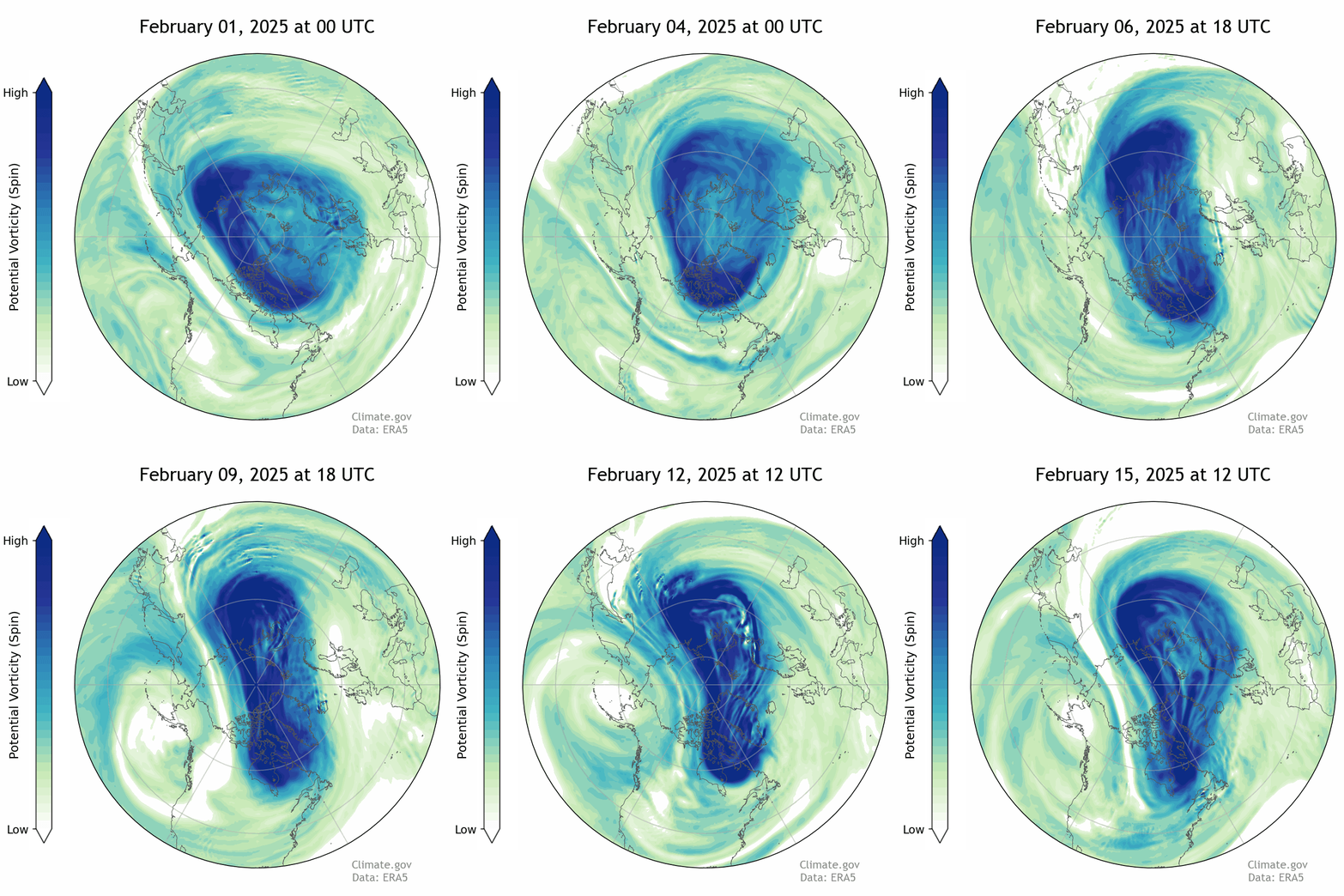
The polar vortex is a massive circulation system—an area of low pressure and frigid air that encircles the North Pole. It resides in the upper atmosphere, spanning the stratosphere and troposphere, and serves as an invisible shield, trapping Arctic cold in the polar regions. When the vortex is robust, it spins steadily, fostering mild and predictable weather in mid-latitude areas like North America. But when it weakens or collapses, that shield fails, allowing cold air masses to spill southward, triggering sharp temperature drops and erratic weather.
Stratospheric Warming: The Trigger for Chaos
A primary driver of the polar vortex’s collapse is stratospheric warming. This occurs when temperatures in the stratosphere—roughly 10–50 km above Earth’s surface—soar abruptly over a short period. These spikes can be sparked by heat waves rising from the troposphere, the layer where our everyday weather forms. Upon reaching the stratosphere, these waves disrupt the polar vortex, slowing its rotation or shattering its structure entirely.
The effects ripple far beyond the Arctic. A weakened vortex releases cold air into regions like the eastern United States and Canada, radically altering local weather conditions. (Explanation).
What Might March 2025 Bring?
Current forecasts, grounded in climate models and atmospheric analysis, point to significant stratospheric warming in March 2025, potentially causing a full collapse of the polar vortex. This isn’t guesswork—it’s based on trends meteorologists are tracking now. Should this unfold, North America could see:
Cold Arctic front: Temperatures in the eastern U.S. and Canada might plunge 10–20 degrees below March norms. Even areas accustomed to mild spring weather could feel an Arctic chill.
Unexpected snow: Higher humidity paired with cold could bring snow to places that rarely see it this late in the year.
Stormy weather: A destabilized vortex may intensify storm systems, leading to frequent, severe precipitation—think freezing rain and strong winds.
These impacts won’t be uniform. The western U.S. might escape largely unscathed, while the eastern seaboard and Canada bear the brunt of this cold invasion.
Impacts on Life and the Economy
Weather isn’t just data—it shapes daily life and economic stability. If these predictions hold, a polar vortex collapse in March 2025 could mean:
Agriculture at risk: Late frosts and snow could harm early crops or delay planting, a major concern for farmers in the central and eastern U.S.
Transportation chaos: Snow, ice, and storms might close roads, delay flights, and snarl logistics.
Energy strain: Colder temperatures will boost heating demand, potentially overloading power grids and driving up electricity costs.
These aren’t hypotheticals—they’re tangible risks that deserve attention from policymakers and residents alike.
Lessons from the Past
Polar vortex collapses aren’t new. History offers stark examples. In January 2014, a disrupted vortex sent Arctic air crashing into the U.S., delivering record lows—down to -40°C in some states—and heavy snow that paralyzed cities like Chicago and New York. More recently, in February 2021, a cold front hit Texas, sparking an energy crisis. These events underscore that a collapsing vortex isn’t a minor quirk—it’s a force that can upend millions of lives.
A Cold March Ahead?
The collapse of the polar vortex and stratospheric warming in March 2025 could transform early spring into a lingering winter across the U.S. and Canada. This isn’t cause for alarm but a call to readiness. Weather is a intricate, unpredictable beast, yet grasping phenomena like the polar vortex equips us to handle its surprises. Keep an eye on forecasts, prepare for a cold snap, and remember: forewarned is forearmed!
Polar Vortex Collapse Brace for Wild Weather in the U.S. and Canada in 2025

Gleb Perov is the founder and chief meteorologist of POGODNIK, a leading weather forecasting service in Eastern Europe. With over 15 years of hands-on experience in meteorology and climate analysis, he has worked private weather services.
Gleb is the author of numerous scientific and analytical publications on climate, magnetic storms, and atmospheric processes. He regularly collaborates with major international agencies such as NOAA, ECMWF.